Q3 · users
Data scientists use it, management buys it
Primary users are data scientists; the buyer and approver is management. A high-frequency, high-usage product.
Product case study
An in-house ML platform, pitched to management.
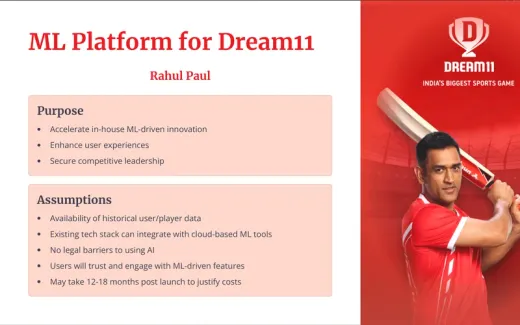
My Dream11 interview case, written before I joined: an investment pitch for building an in-house ML platform. I made the build-or-buy case, scored 26 sub-features into three releases, costed v1, and drew the system and its console.
As givenDream11, India's leading fantasy sports platform, aims to build a robust ML platform to enhance its machine-learning capabilities. Create an investment pitch deck for Dream11 management, highlighting the platform's vision, potential impact, and execution strategy to convince them of the idea and the execution plan.
Q3 · users
Primary users are data scientists; the buyer and approver is management. A high-frequency, high-usage product.
Q7 · scope
The one answer on which use cases the platform must cover.
Q4 to Q6 · unknowns
Existing in-house solutions, technical and cost constraints and the v1 timeline are left to the case: take assumptions and state them.
Q1, Q2 · format
PPT format. Keep it relevant; the length is up to the author.
Where this comes fromI wrote this deck in January 2025 for my Dream11 interview, before I joined as a Product Manager that February. What I worked on in the role is on the Career page.
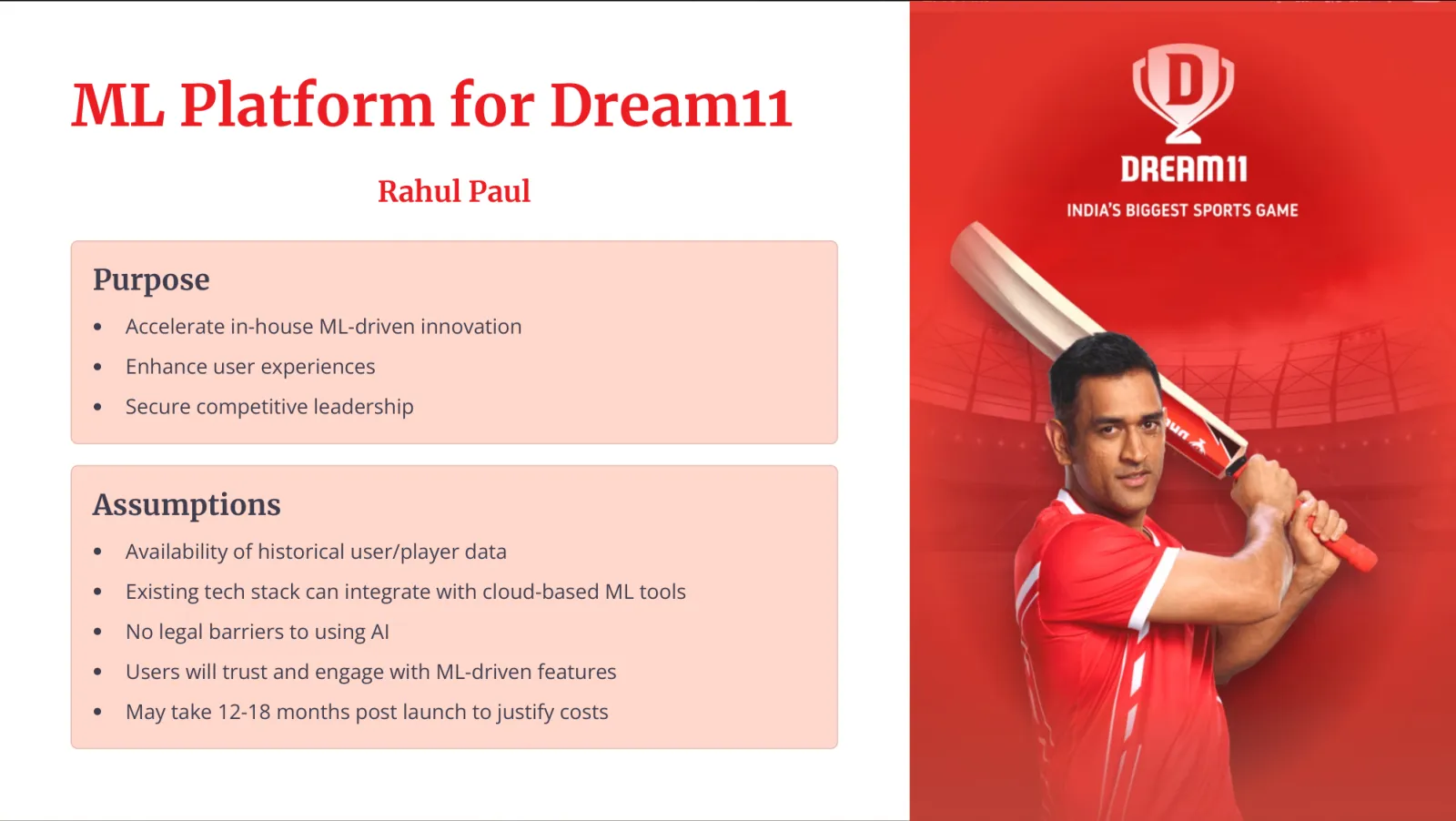
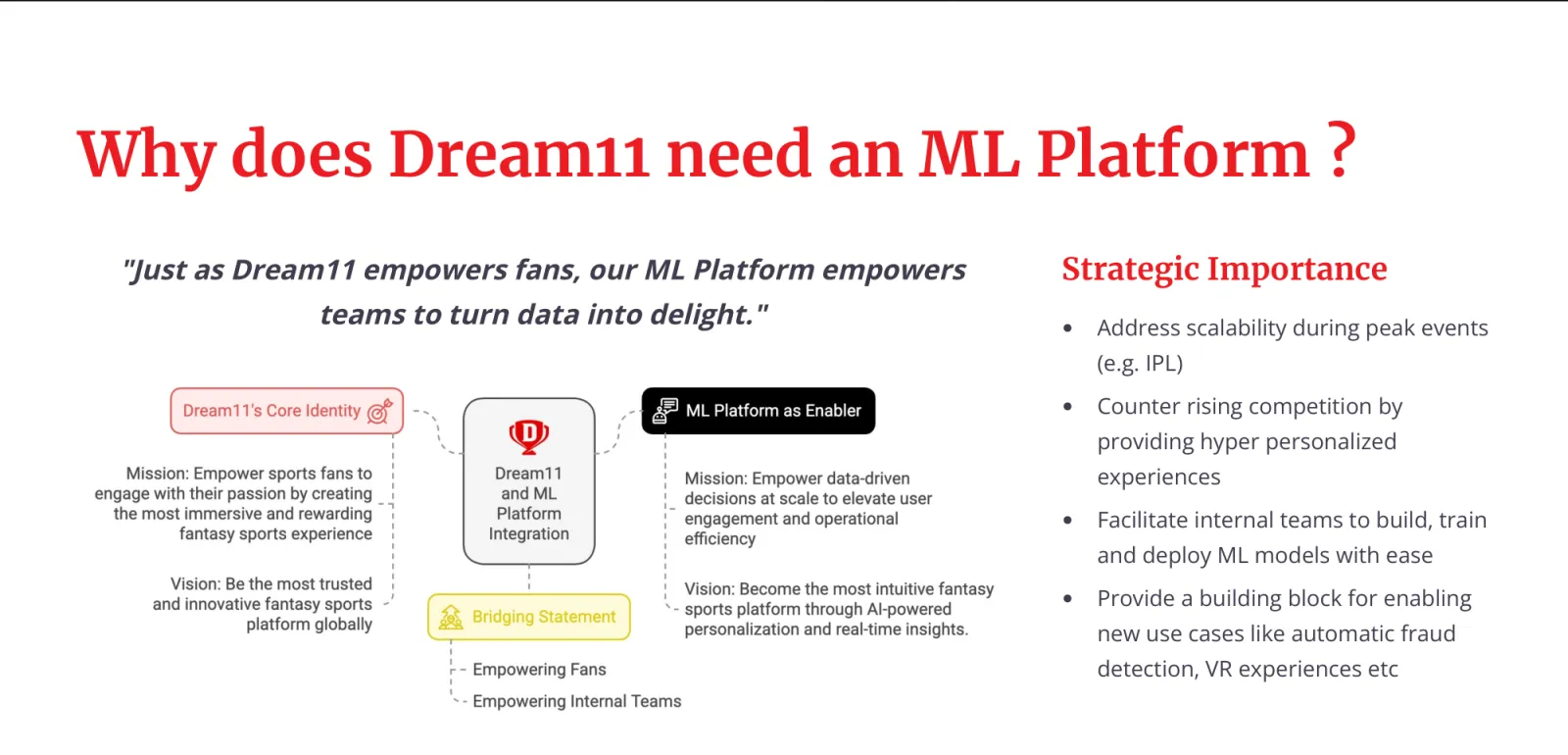
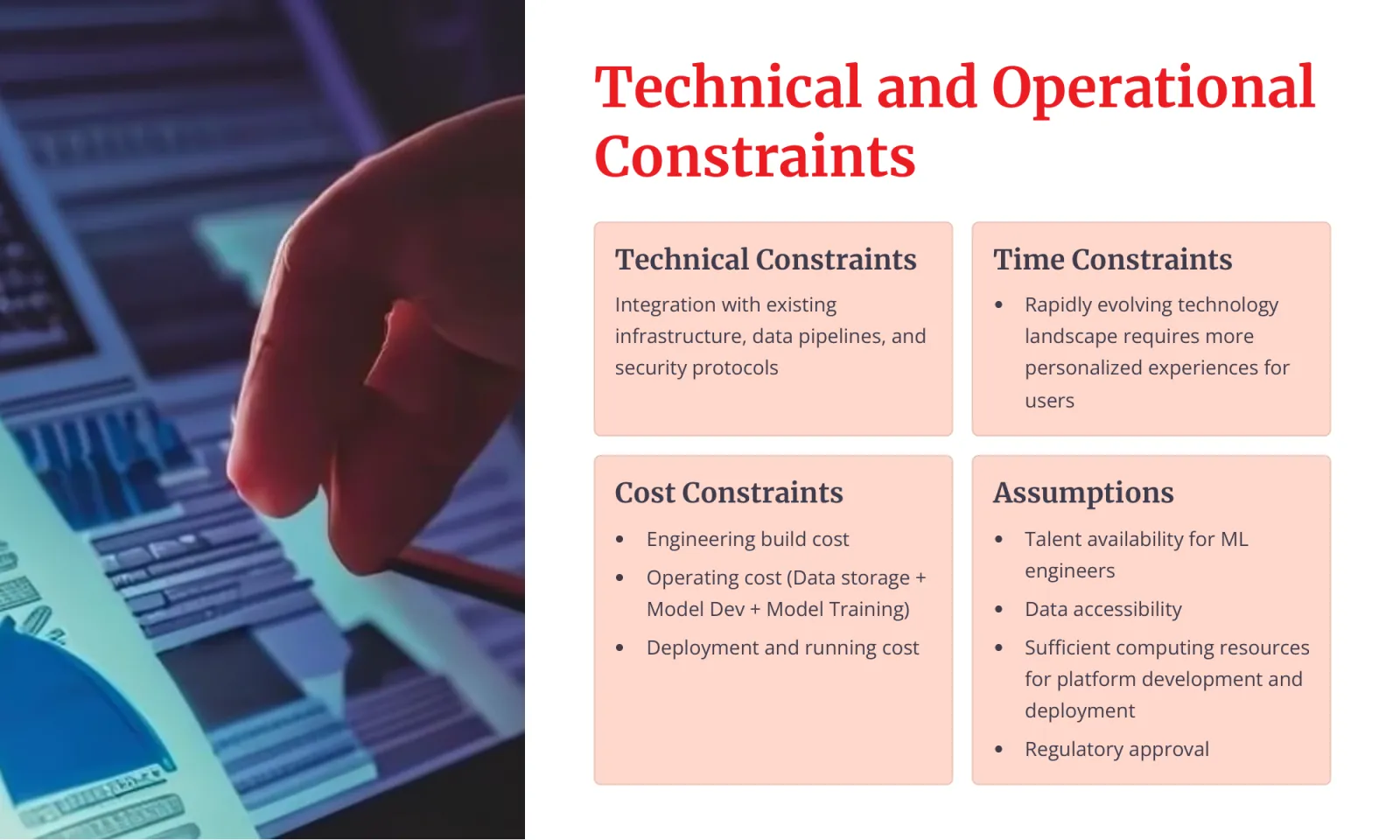
The ideaAn in-house ML platform for Dream11's data scientists: one system from ingestion to serving, with a build-or-buy case, a console and a phased roadmap. A pitch, not a product.
01
Seven clarifying answers set the users, the buyer and what the pitch had to assume.
The brief02
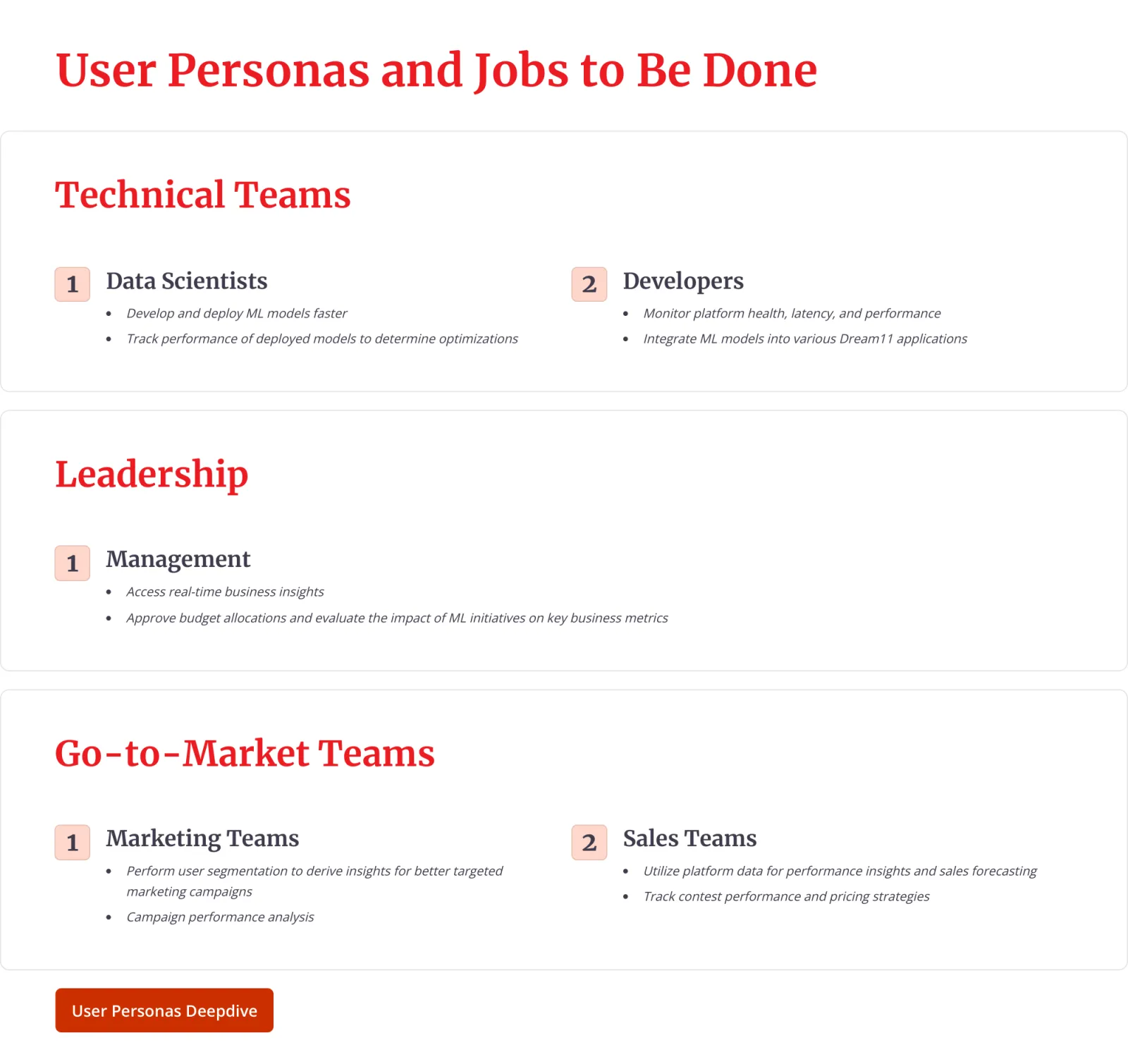
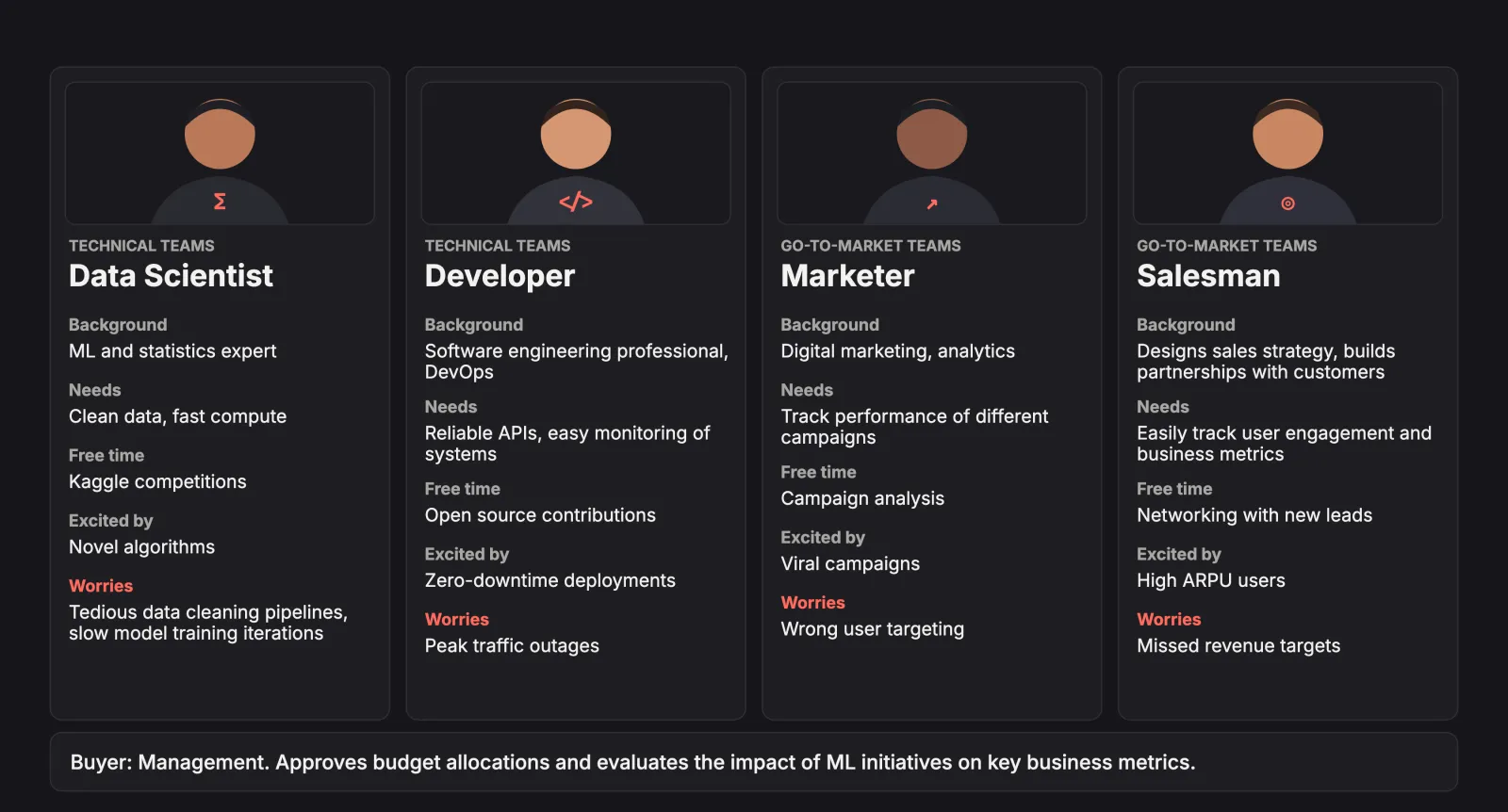
Five user groups on the slide, four of them profiled from interviews with 10 people, so the platform starts from real jobs.
Who it is for03
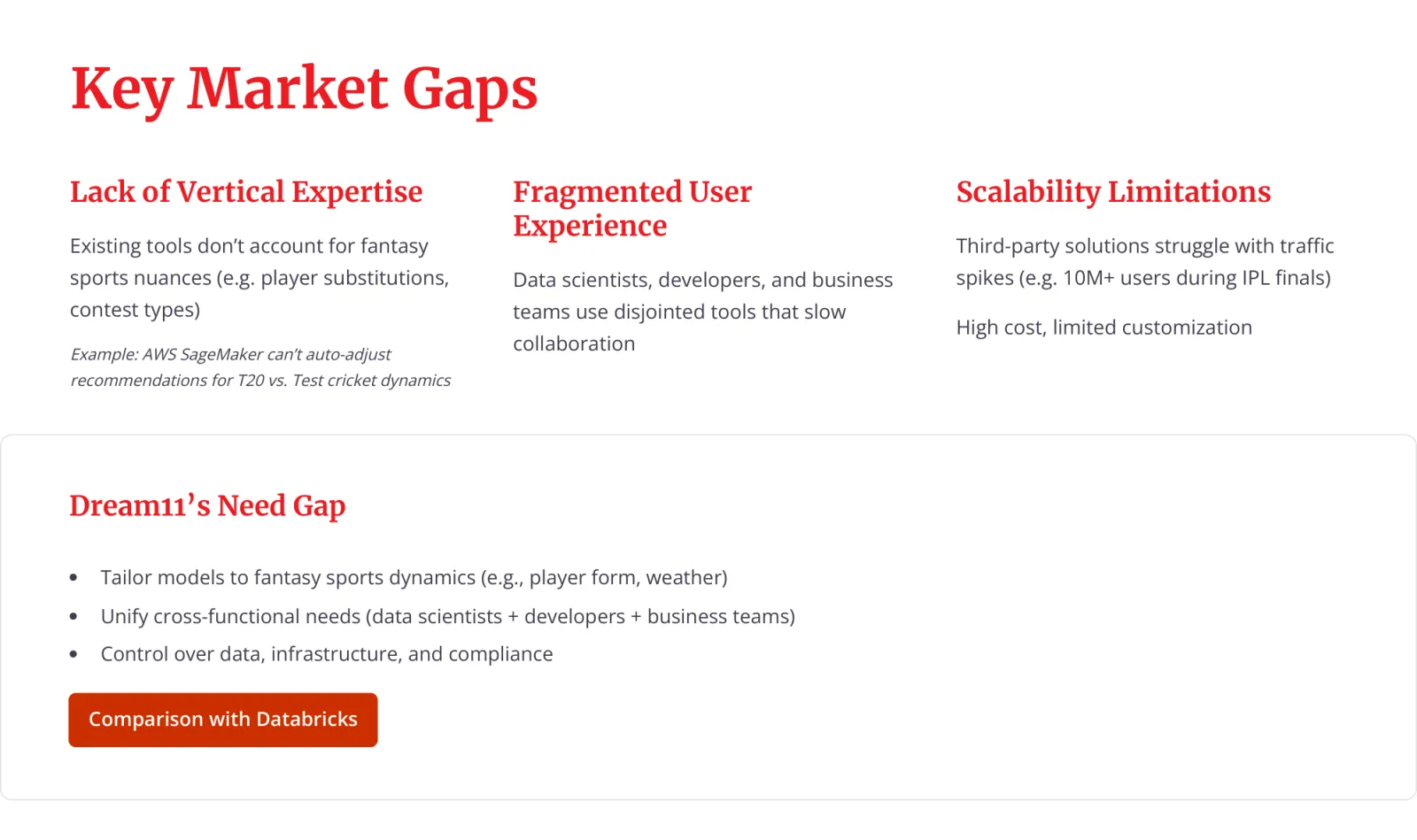
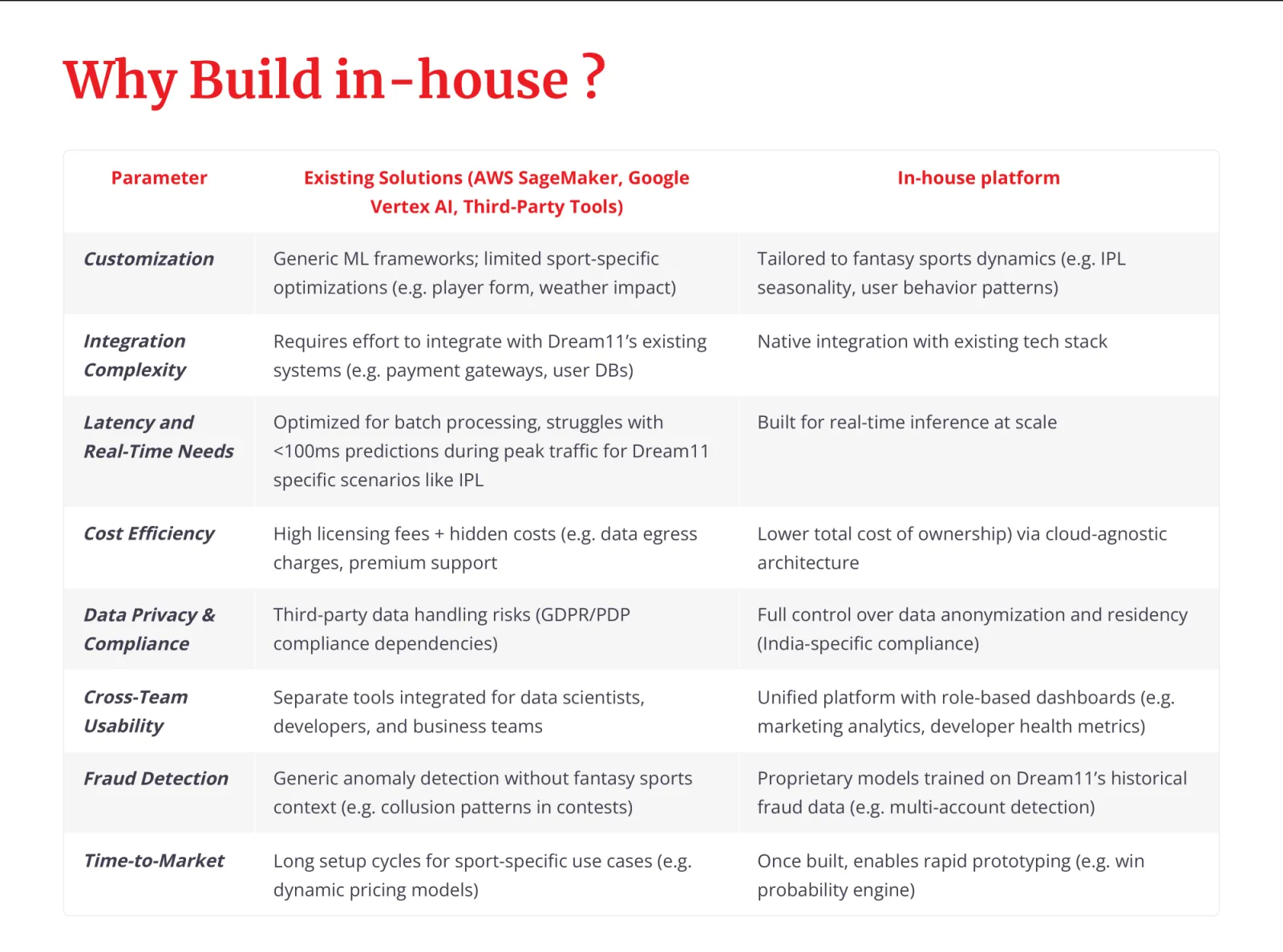
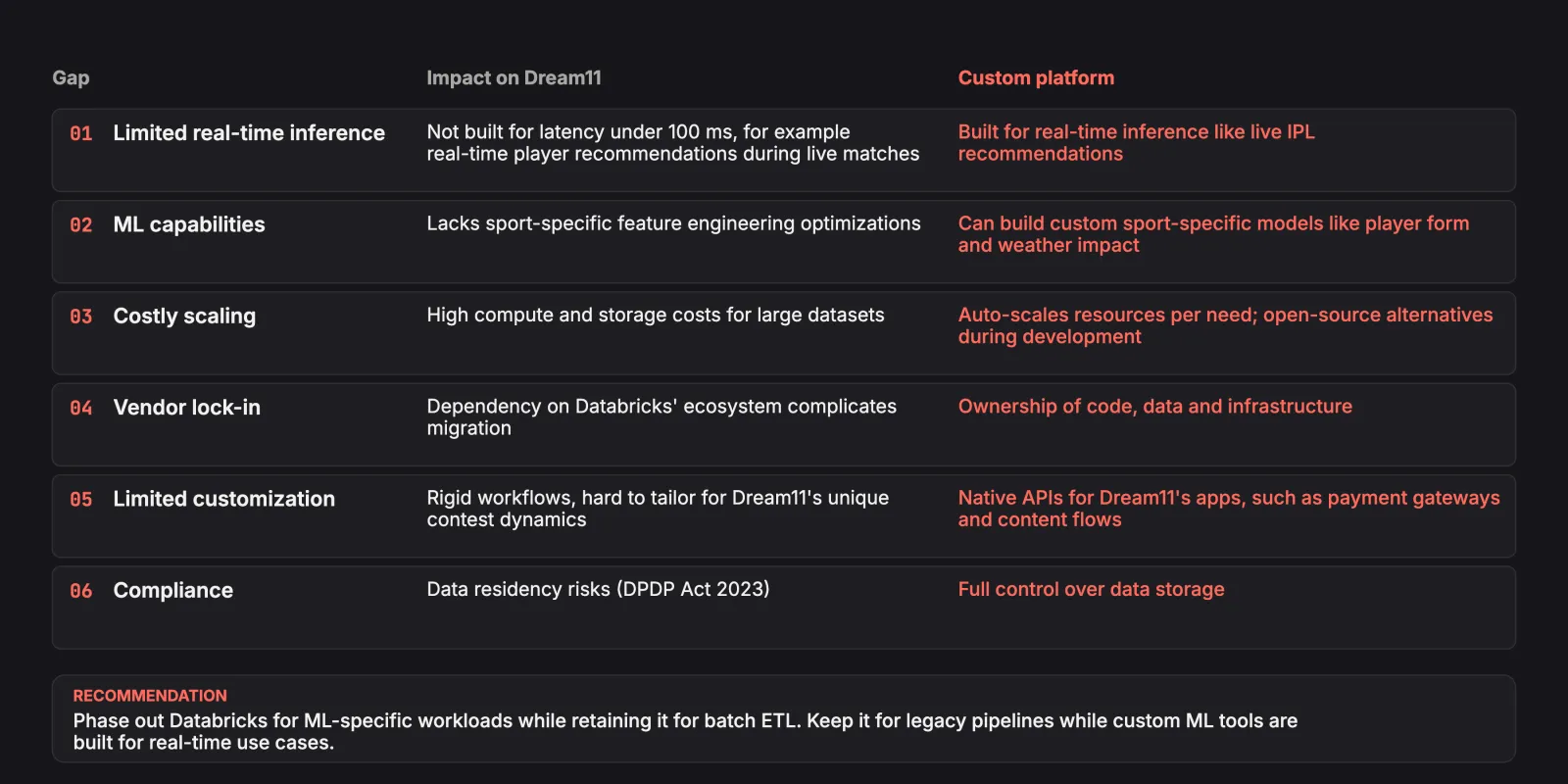
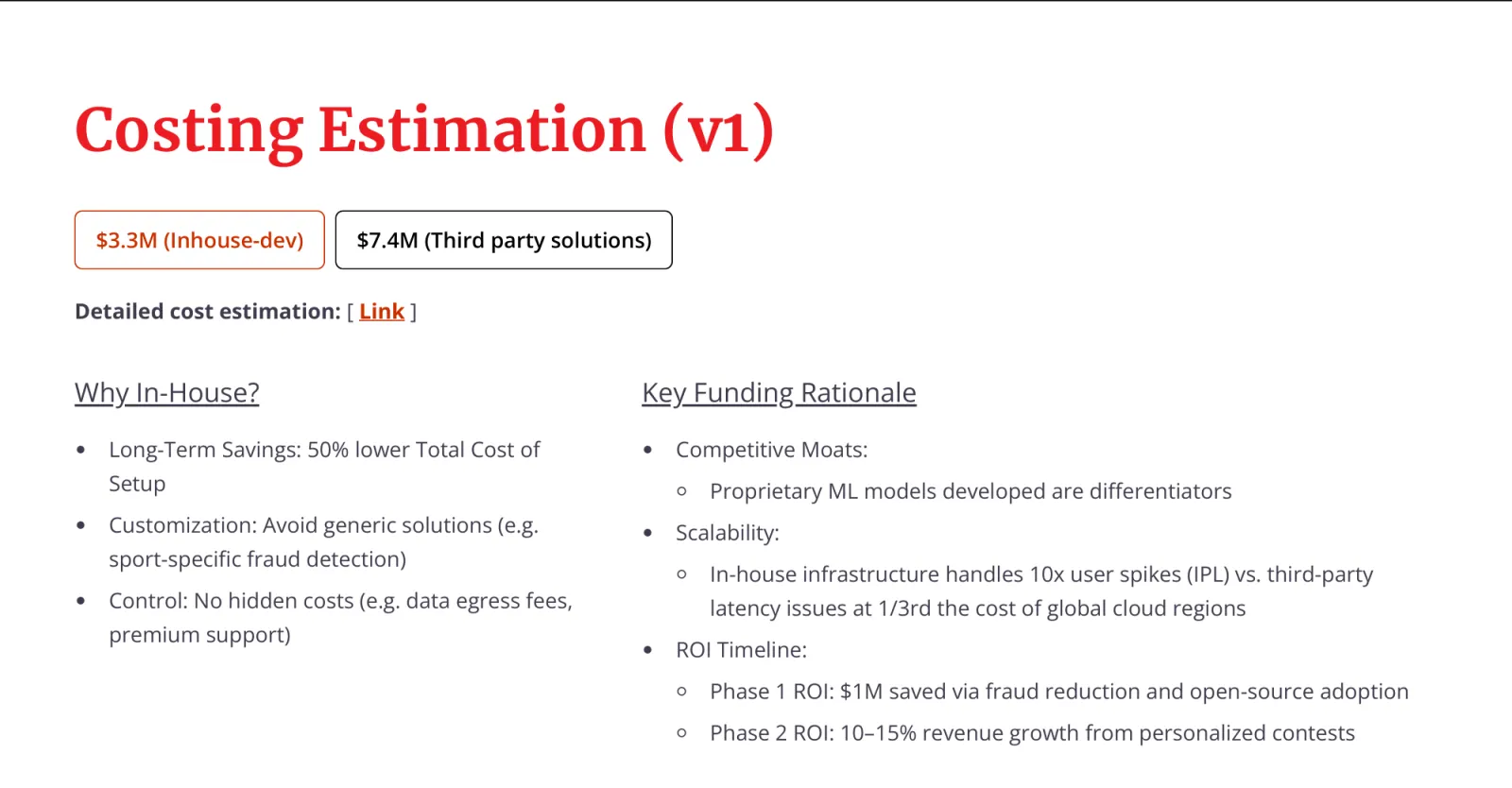
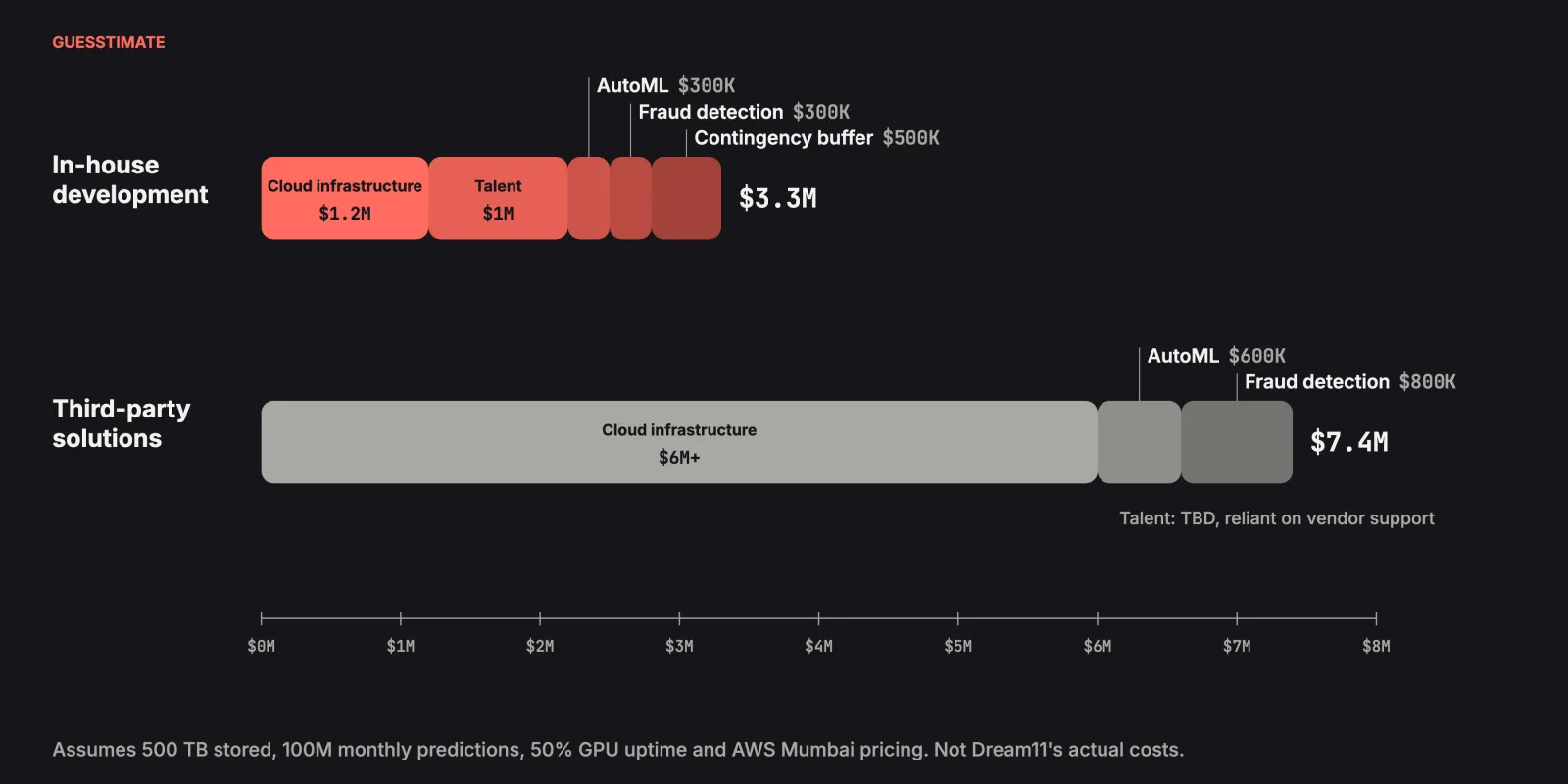
Eight parameters, a Databricks comparison and a v1 guesstimate make the case for in-house. The costs are guesses, not Dream11's figures.
Build or buy04
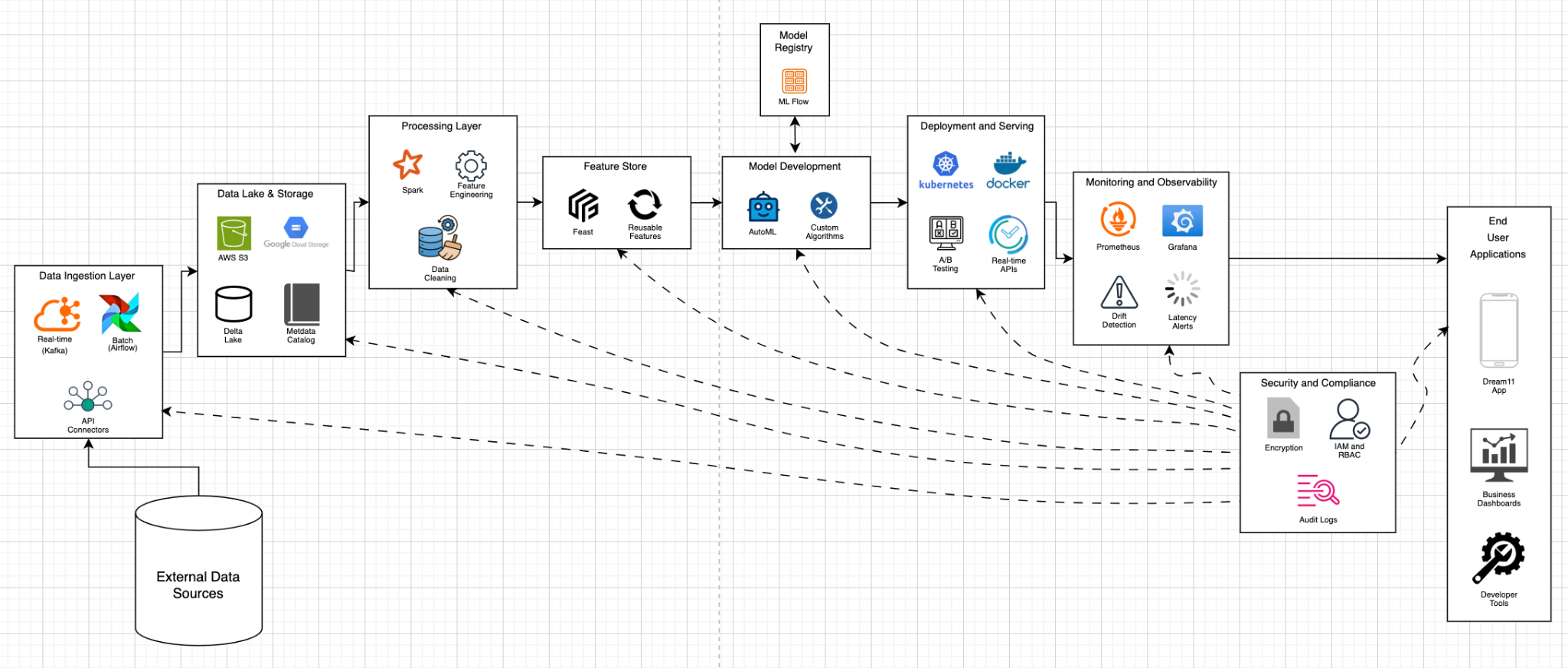
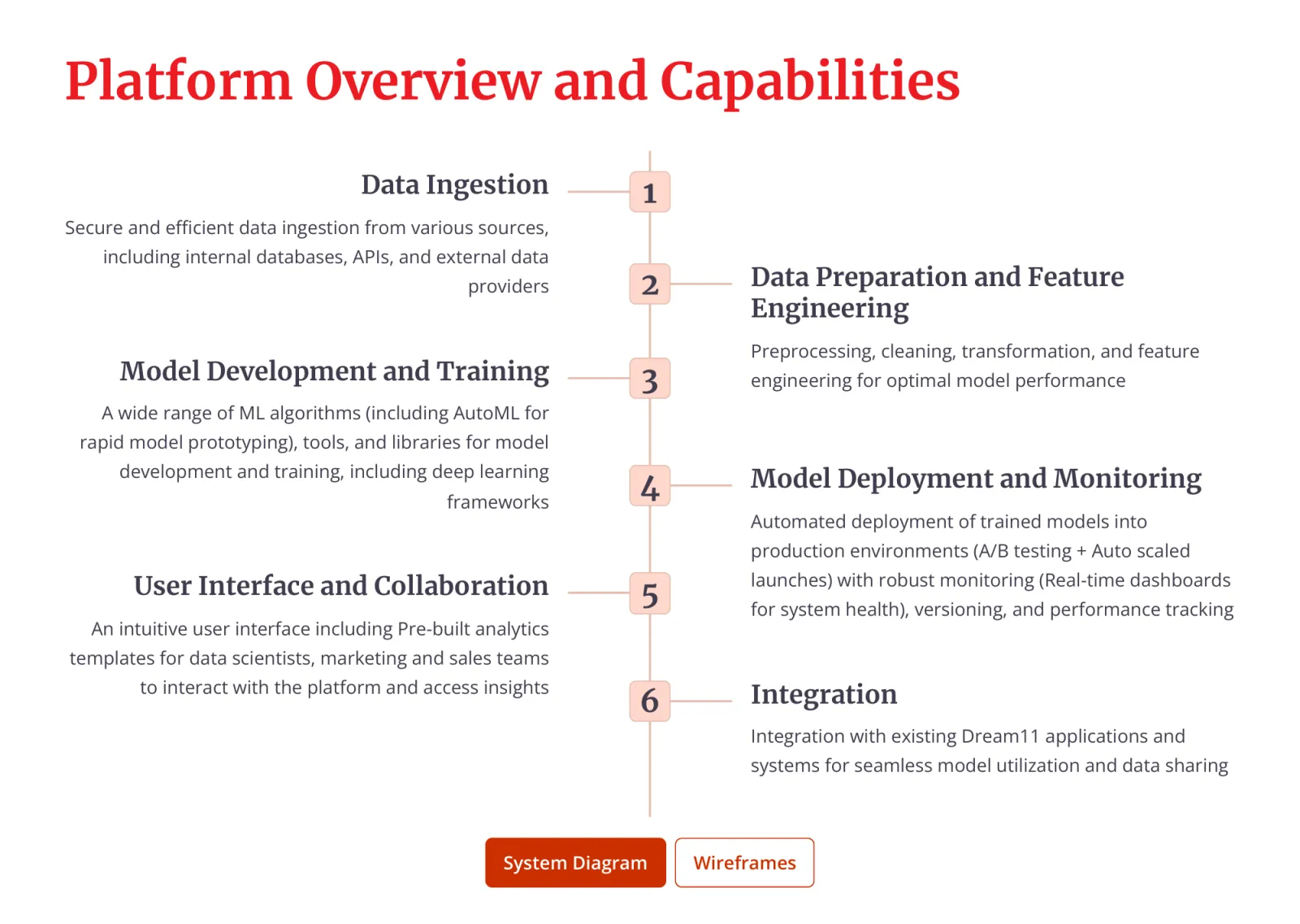
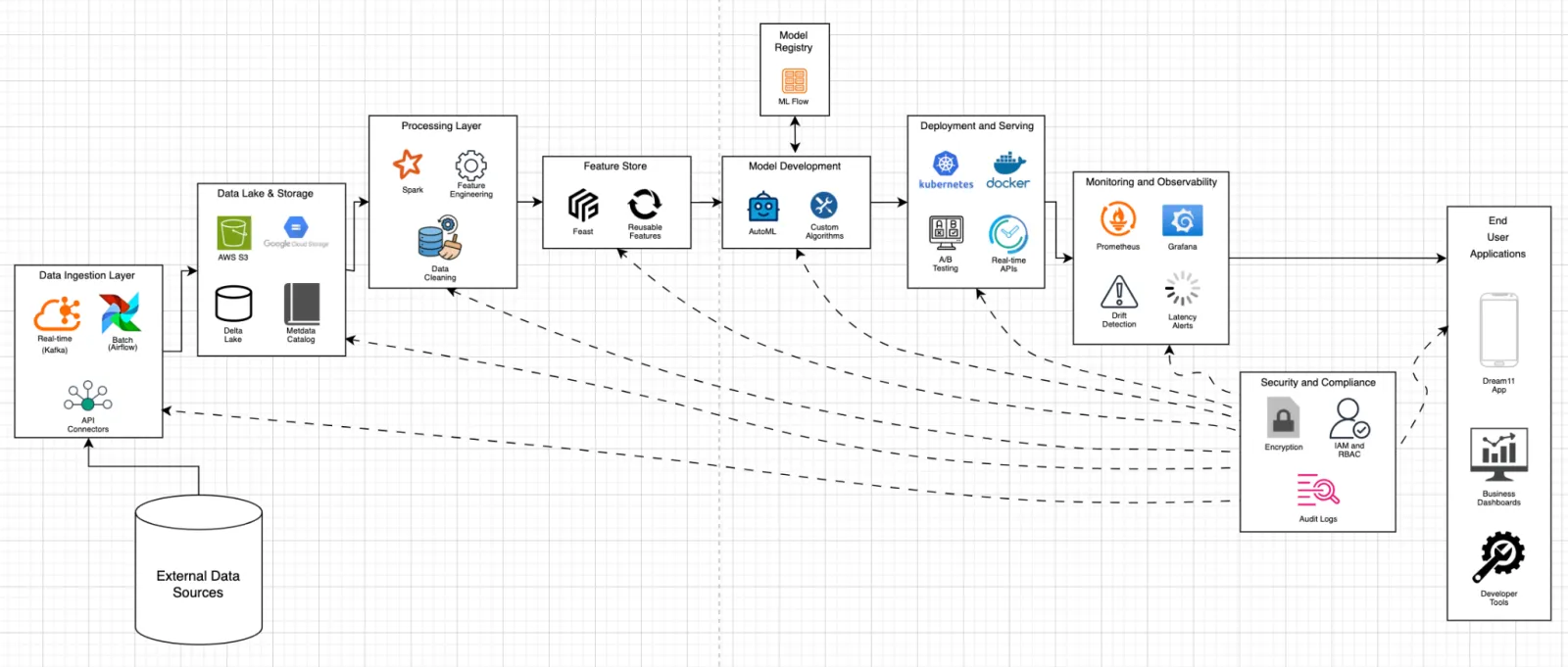
8 layers, from ingestion and storage to serving, monitoring and security, joined into one architecture.
The platform05
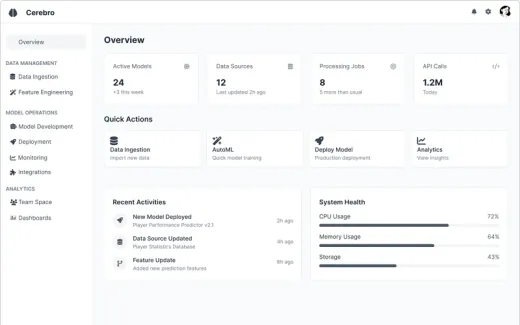
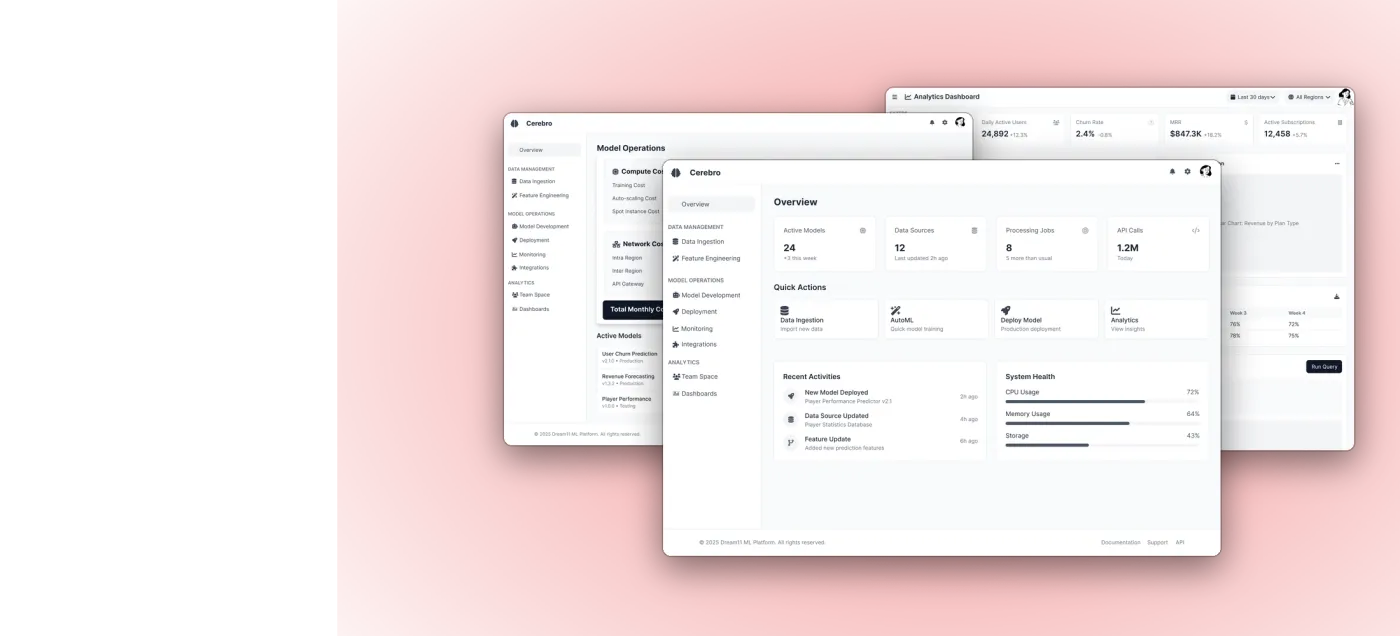
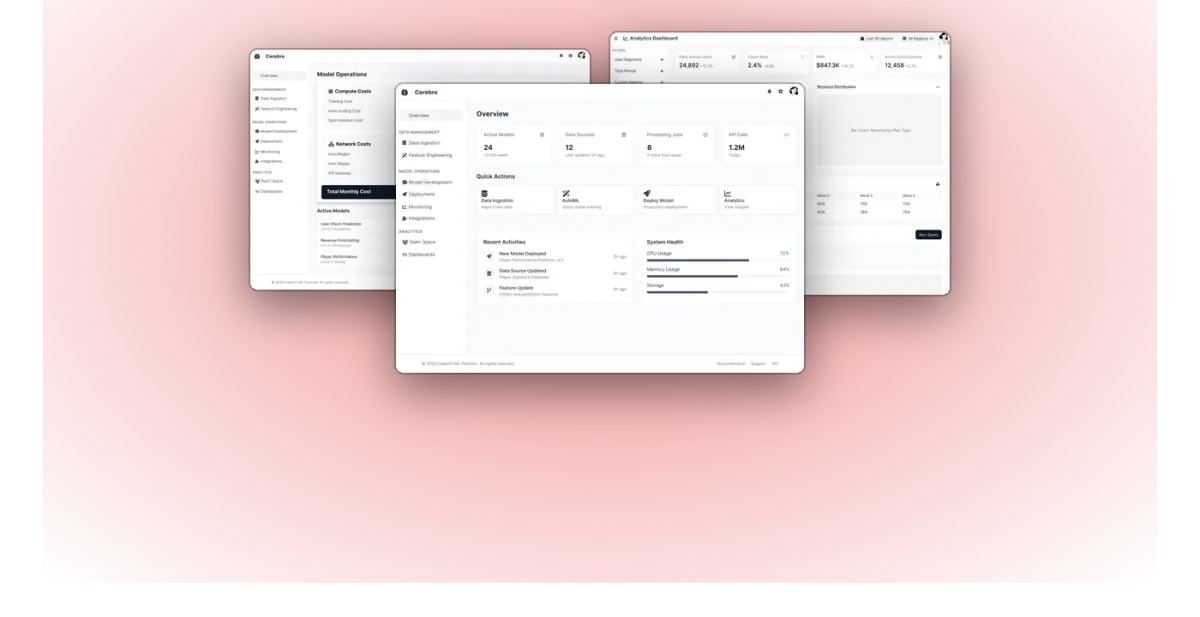
Three wireframed screens for the console, Cerebro: an overview, model operations and analytics.
The wireframes06
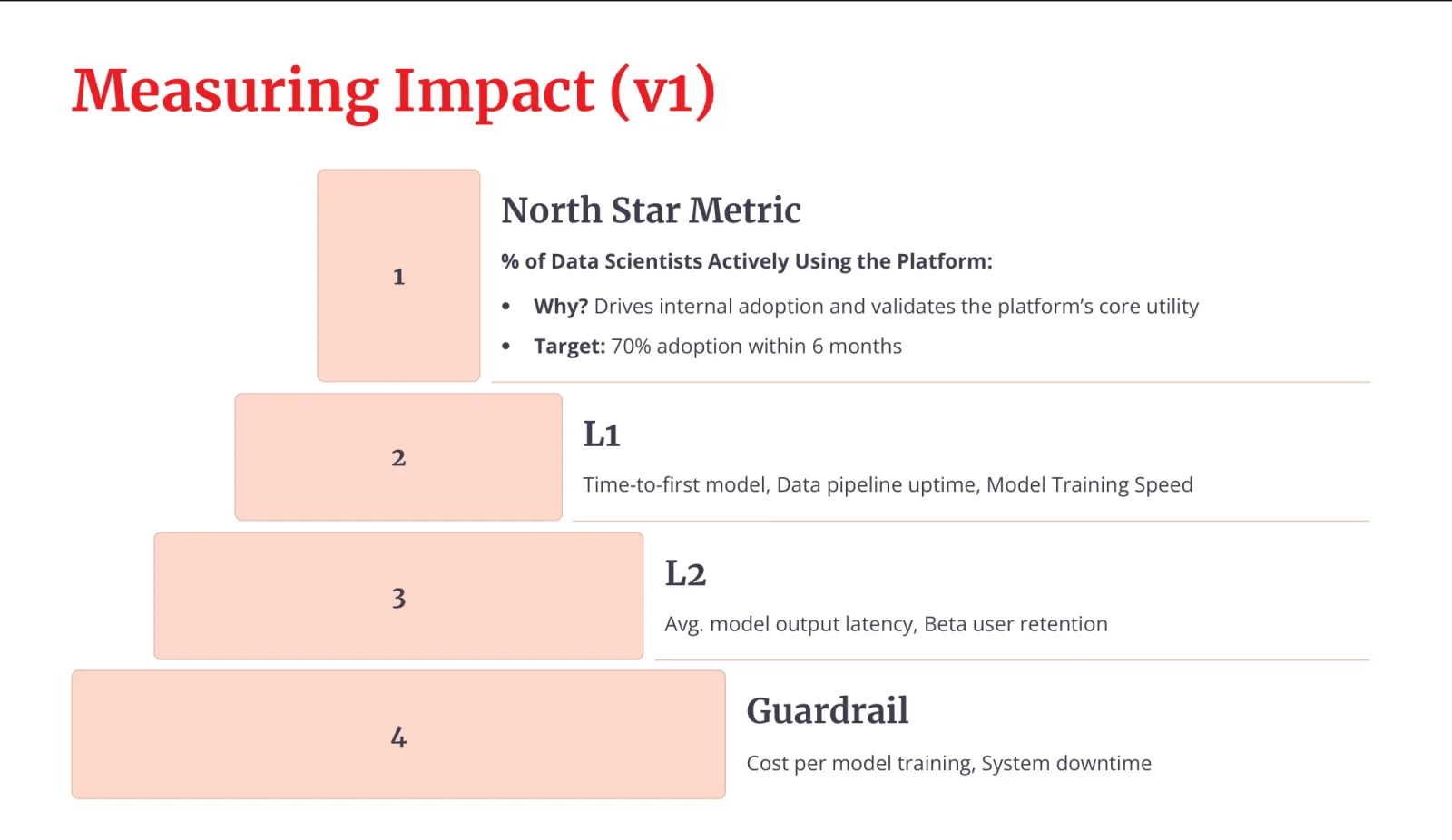
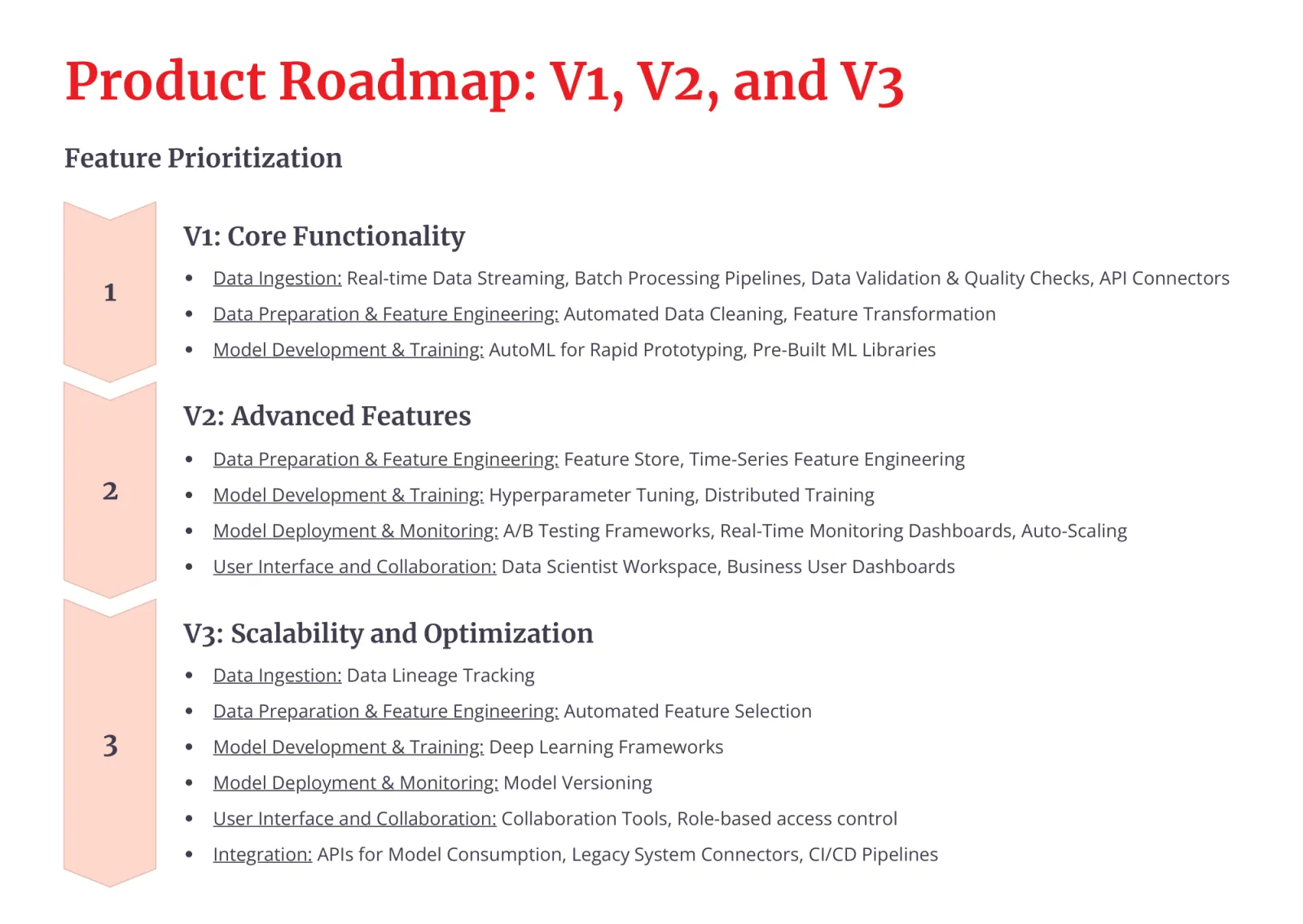
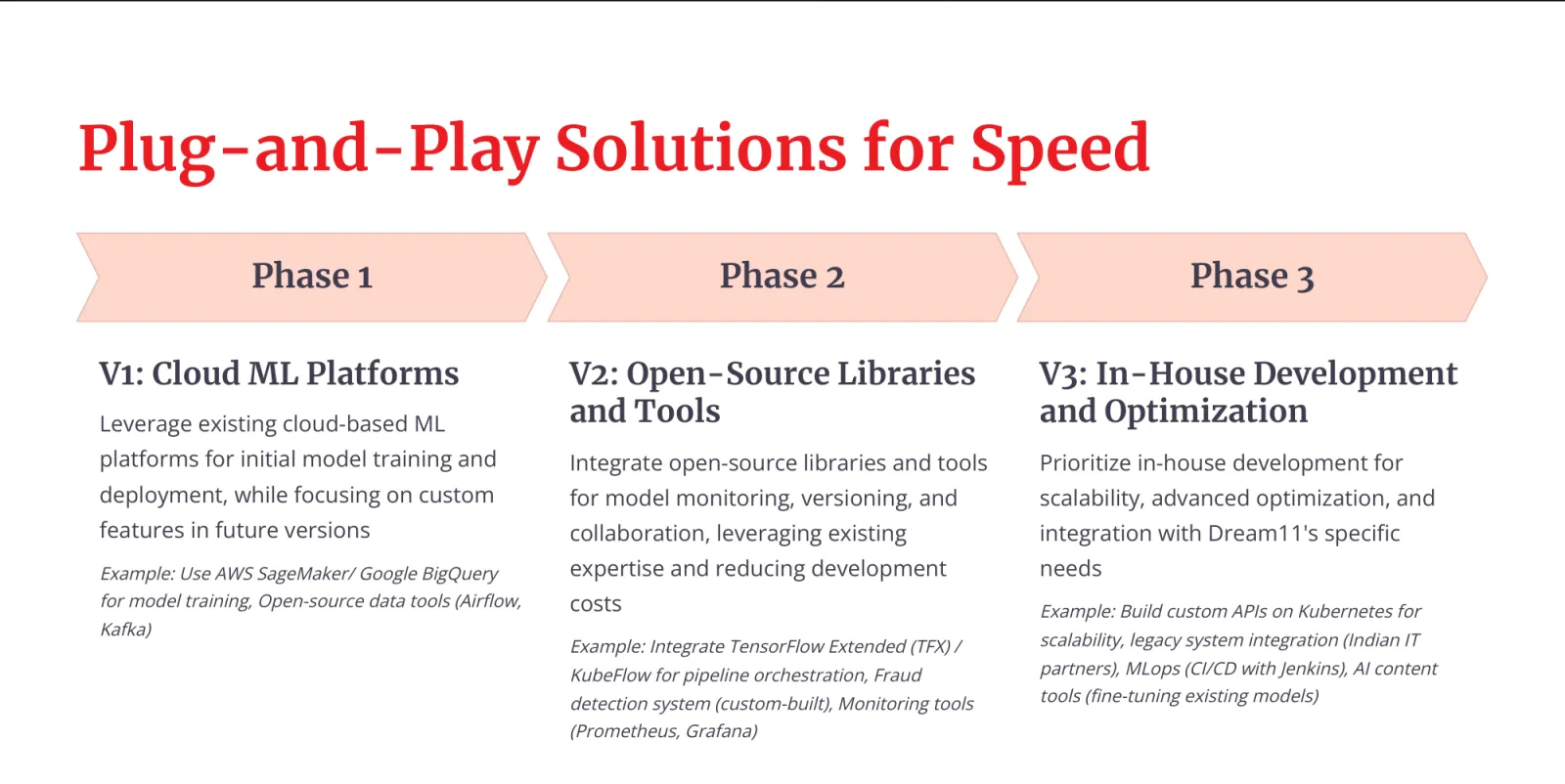
26 sub-features scored on four parameters and sorted into V1 to V3. The north star is proposed, never measured.
The roadmapEvery figure on the screens is a placeholder the wireframe was drawn with.
1 / 3
Step 01
The landing screen: four counters, four quick actions, recent activity and system health. The numbers are placeholders.
Step 02
Monthly cost itemised under compute, storage, network and inference, with one total, above the list of active models.
Step 03
The business view: four headline numbers, two chart placeholders, retention cohorts and a SQL playground.
Step 1
| Compute, GPU and CPU | $60K |
| Storage, S3 or a GCP bucket | $20K |
| Networking | $5K |
| Managed services | $10K |
| Total | $95K |
$95K a month is $1.14M a year, which the appendix rounds to $1.2M.
Cloud, a year$1.2M
Step 2
| Databricks units | $300K |
| Compute on SageMaker | $100K |
| Storage on Delta Lake | $50K |
| Data transfer and egress | $30K |
| Support and licensing | $20K |
| Total | $500K |
The appendix prices 100,000 units at $0.30 each as $300K; that product is $30K. Shown as written.
Cloud, a year$6M
Step 3
| Cloud infrastructure | $1.2M |
| Talent: 8 ML engineers, 4 data scientists, 2 architects | $1M |
| AutoML on open-source tools | $300K |
| Fraud detection, custom-built | $300K |
| Contingency buffer | $500K |
| Total | $3.3M |
Third party: $6M cloud, $600K AutoML and $800K fraud detection, $7.4M in all, with talent left as TBD.
Against third party$3.3M vs $7.4M
01
Real-time with Kafka, batch with Airflow, and API connectors to external data sources.
02
AWS S3, Google Cloud Storage, Delta Lake and a metadata catalog.
03
Spark, feature engineering and data cleaning.
04
Feast, holding reusable features.
05
AutoML and custom algorithms, with a model registry on MLflow.
06
Kubernetes, Docker, A/B testing and real-time APIs.
07
Prometheus, Grafana, drift detection and latency alerts.
08
Encryption, IAM and RBAC, and audit logs, connected to every layer.
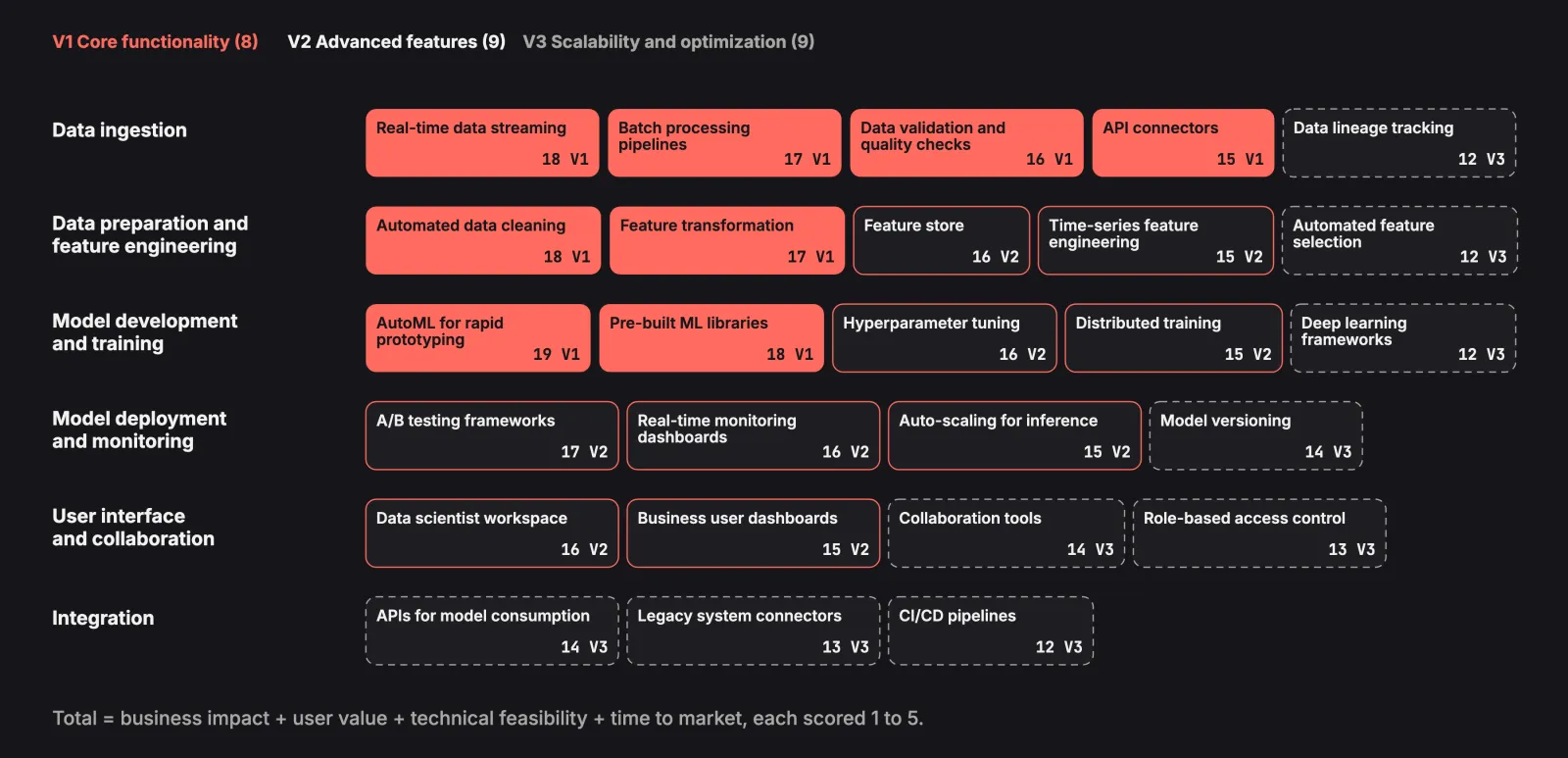
| Data ingestion | BI | UV | TF | TTM | Total | In |
|---|---|---|---|---|---|---|
| Real-time data streaming | 5 | 5 | 4 | 4 | 18 | V1 |
| Batch processing pipelines | 5 | 4 | 4 | 4 | 17 | V1 |
| Data validation and quality checks | 4 | 5 | 4 | 3 | 16 | V1 |
| API connectors | 4 | 4 | 3 | 4 | 15 | V1 |
| Data lineage tracking | 3 | 3 | 2 | 4 | 12 | V3 |
| Data preparation and feature engineering | BI | UV | TF | TTM | Total | In |
|---|---|---|---|---|---|---|
| Automated data cleaning | 5 | 5 | 4 | 4 | 18 | V1 |
| Feature transformation | 5 | 4 | 4 | 4 | 17 | V1 |
| Feature store | 4 | 5 | 3 | 4 | 16 | V2 |
| Time-series feature engineering | 4 | 4 | 3 | 4 | 15 | V2 |
| Automated feature selection | 3 | 3 | 3 | 3 | 12 | V3 |
| Model development and training | BI | UV | TF | TTM | Total | In |
|---|---|---|---|---|---|---|
| AutoML for rapid prototyping | 5 | 5 | 4 | 5 | 19 | V1 |
| Pre-built ML libraries | 5 | 5 | 4 | 4 | 18 | V1 |
| Hyperparameter tuning | 4 | 4 | 3 | 5 | 16 | V2 |
| Distributed training | 4 | 4 | 2 | 5 | 15 | V2 |
| Deep learning frameworks | 3 | 3 | 2 | 4 | 12 | V3 |
| Model deployment and monitoring | BI | UV | TF | TTM | Total | In |
|---|---|---|---|---|---|---|
| A/B testing frameworks | 5 | 4 | 4 | 4 | 17 | V2 |
| Real-time monitoring dashboards | 4 | 5 | 3 | 4 | 16 | V2 |
| Auto-scaling for inference | 4 | 4 | 3 | 4 | 15 | V2 |
| Model versioning | 3 | 3 | 3 | 5 | 14 | V3 |
| User interface and collaboration | BI | UV | TF | TTM | Total | In |
|---|---|---|---|---|---|---|
| Data scientist workspace | 4 | 5 | 4 | 3 | 16 | V2 |
| Business user dashboards | 4 | 4 | 4 | 3 | 15 | V2 |
| Collaboration tools | 3 | 4 | 3 | 4 | 14 | V3 |
| Role-based access control | 3 | 3 | 3 | 4 | 13 | V3 |
| Integration | BI | UV | TF | TTM | Total | In |
|---|---|---|---|---|---|---|
| APIs for model consumption | 4 | 4 | 3 | 3 | 14 | V3 |
| Legacy system connectors | 3 | 3 | 2 | 5 | 13 | V3 |
| CI/CD pipelines | 3 | 3 | 3 | 3 | 12 | V3 |
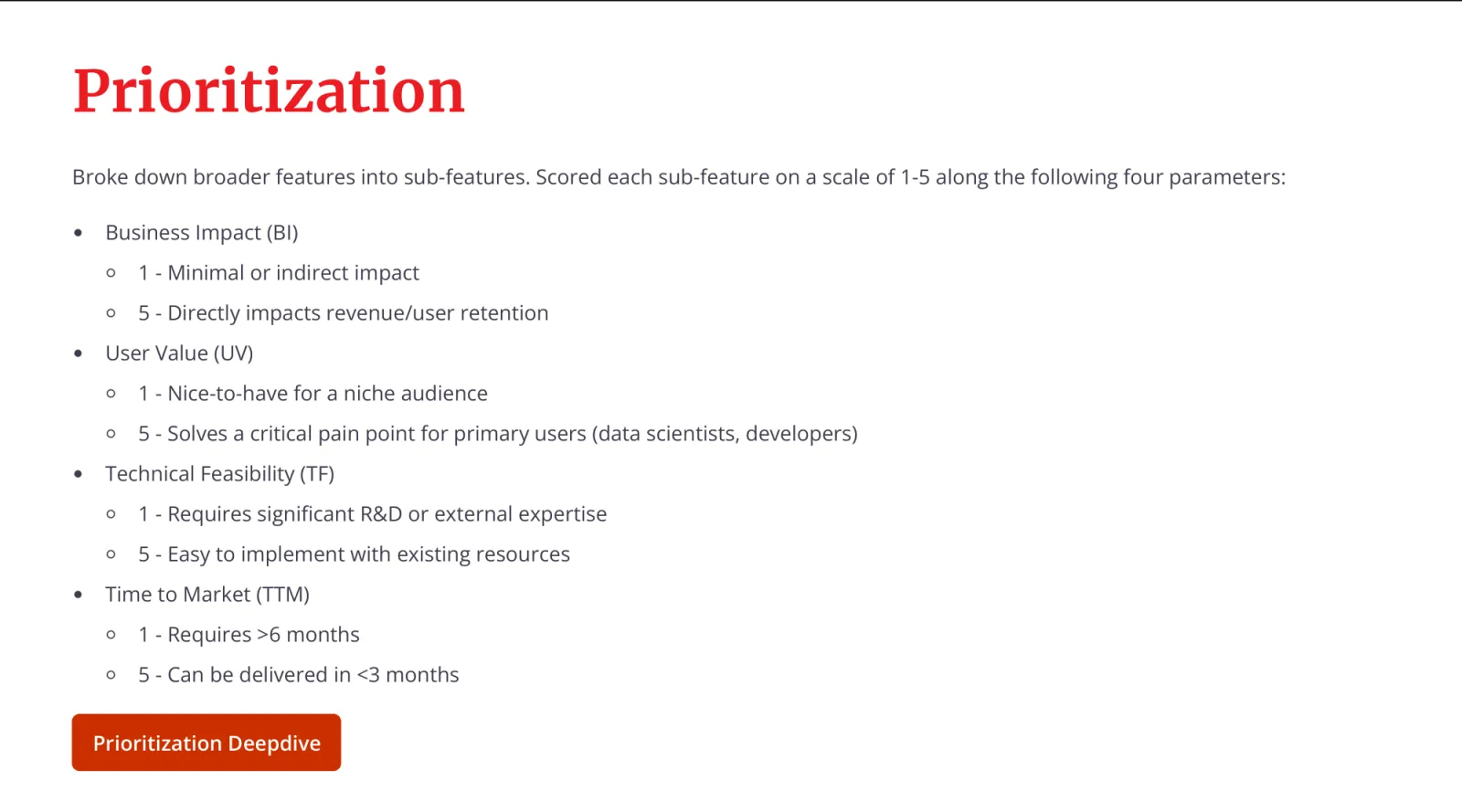
From the appendix, each parameter out of 5: BI business impact, UV user value, TF technical feasibility, TTM time to market. The release is the one slide 10 gives; the appendix holds the reason for each score.
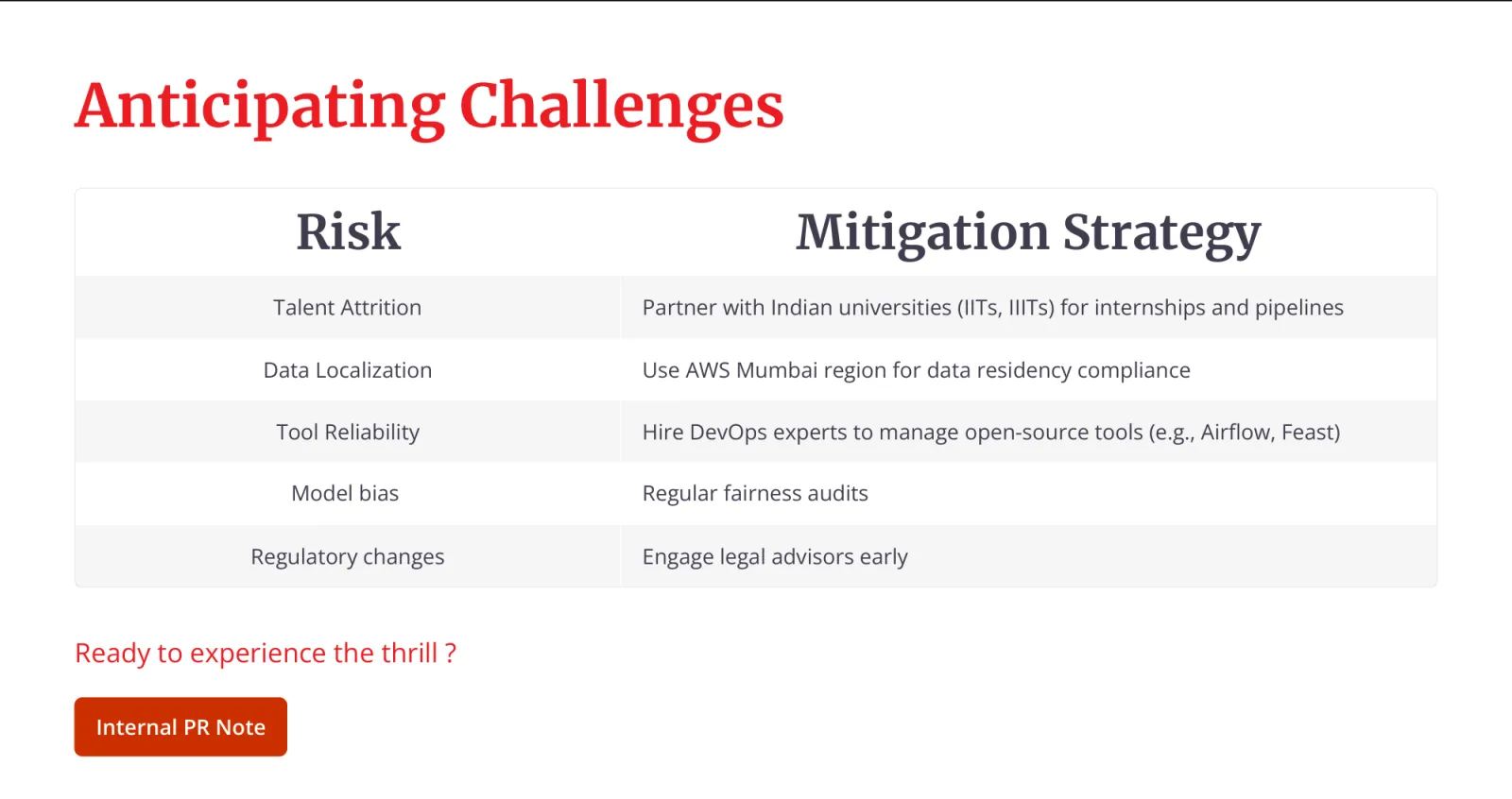
Internal PR note for v1, from the appendix
Hi Team, we're thrilled to announce the launch of Dream11's in-house ML Platform, designed to supercharge your workflows and transform user experiences! Get started: explore tutorials and sandbox environments at [internal link]. Training sessions start next week!
Focus on innovation, not infrastructure.
Scale seamlessly during IPL peaks.
Target users with hyper-personalized campaigns.
The PR note is part of the interview case, written as if the platform had launched. Nothing in this deck describes what Dream11 built.
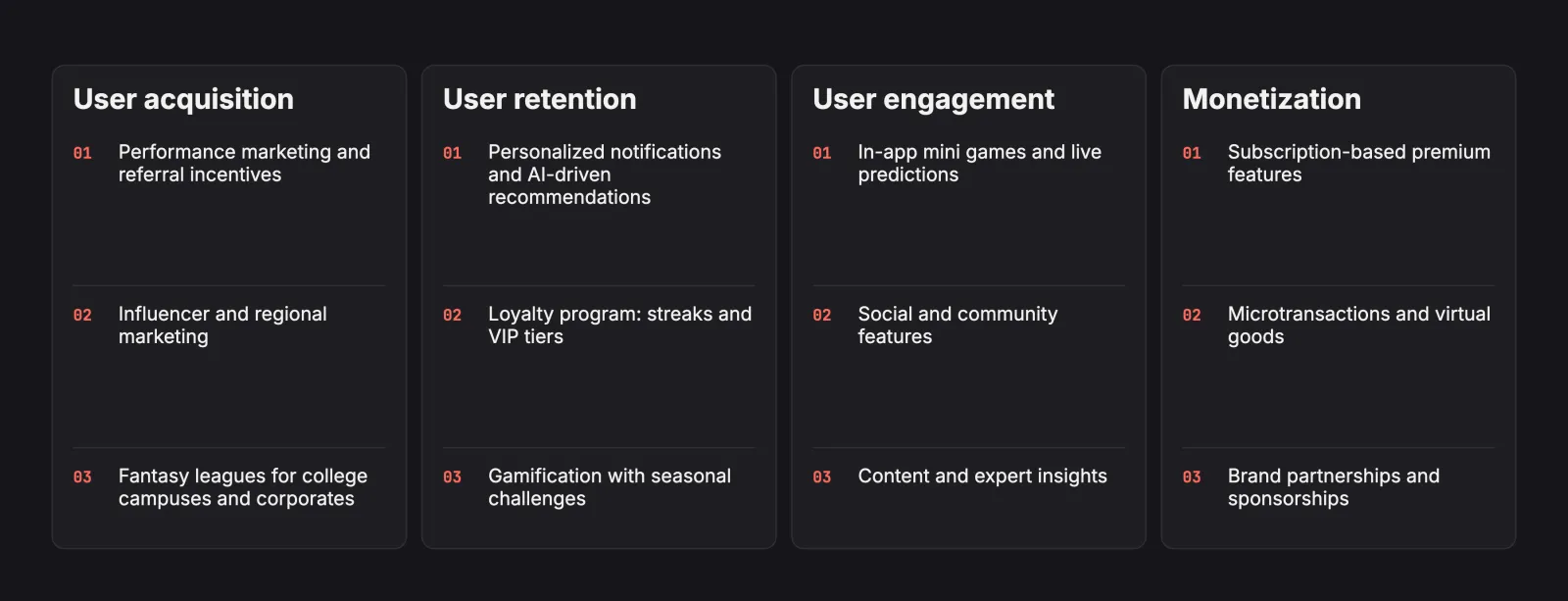
The sources, as written. The deck is the public copy: its closing slide, which holds only contact details, is left out.
Download the original documents (zip)PDF · Jan 2025
Image · Jan 2025
Figma