Hirer side
Finding the real candidates
Share of applicants advancing to review, time to first qualified applicant, cost per qualified applicant.
Product case study
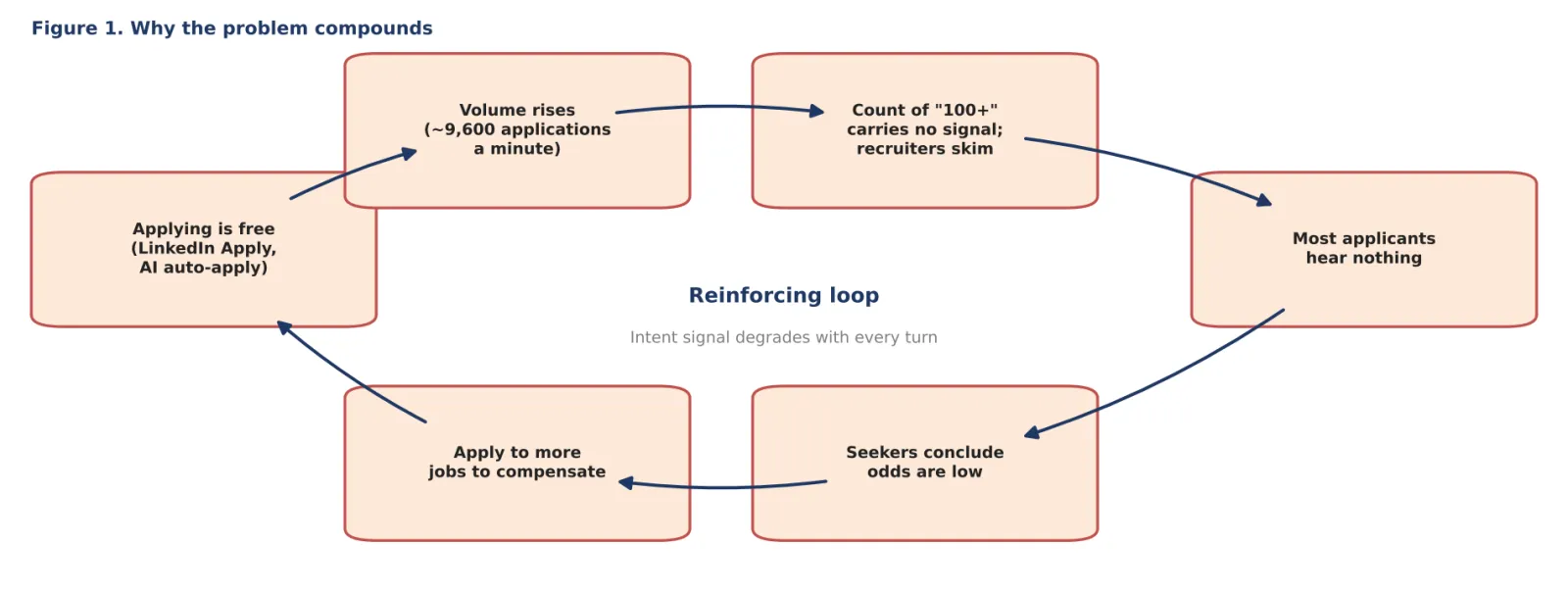
Applying is free, so intent is noise.
My own exploration of a LinkedIn problem: an application no longer shows who really wants the job. A scarce, refundable Priority Application evolves Top Choice, with five features, three wireframes, a metrics pyramid, a scenario business case and an experiment.
Application signal collapseApplying costs seekers nothing, so application volume is a poor proxy for intent. Hirers sift through noise, seekers hear nothing back, and the marketplace promise of the right number of quality applicants, at the right speed and price, weakens. Microsoft's FY26 10-K reports LinkedIn revenue growth of 11% against 41% for Azure, and its FY27 restatement folds LinkedIn's parts into other lines, so LinkedIn is no longer reported as a standalone unit.
| Issue | Delight | Hard to copy | Margin moving | Priority | Why this ranking |
|---|---|---|---|---|---|
| Applications are a free, noisy intent signal | High | High | High | P1 | Acts on the root cause and helps both sides of the marketplace. Relies on the identity graph a competitor cannot clone. |
| Agent access is policed by detection, with no sanctioned path | Medium | High | Medium | P2 | Defensible because it is identity-bound, but revenue is speculative and it cuts against LinkedIn's anti-scraping stance. Needs research to size. |
| AI interviews run on a small minority of jobs | Medium | Medium | High | P2 | A clear hirer upsell and a source of verified intent for the P1 fix, though other firms are adding AI hiring loops too. |
| Early-applicant advantage rewards speed over fit | Medium | Low | Medium | P2 | A mechanism of the root cause, and the evidence is a single statement. Best addressed once volume has been reshaped. |
| Match scores give no path to improve | High | Medium | Medium | P3 | Seekers like it, but it risks keyword gaming and has the weakest tie to hirer-side revenue. |
The full matrix: the evidence and the proposed product change behind each score, and how the DHM model is read.
Download the prioritization matrix (PDF) (opens in a new tab)The Word fileWhat I am solvingThe P1 only: applications are a free, noisy intent signal. It acts on the root cause, helps both sides and rests on the identity graph a competitor cannot clone. The rest are parked. A verified agent tier stays a later option. AI interviews reach the priority lane as the AI-screen filter and a reason for the label. The early-applicant advantage is partly handled by the fit-and-intent sort in F3. The match coach has the weakest tie to hirer revenue.
Hirer side
Share of applicants advancing to review, time to first qualified applicant, cost per qualified applicant.
Seeker side
Response rate per application, applications per hire.
Platform side
False-positive restriction rate for legitimate users.
Hirers pay for access to qualified candidates. If review time per hire rises, a posting is worth less.
Microsoft's FY26 10-K says LinkedIn revenue increased 11% against 41% for Azure. Its FY27 restatement folds LinkedIn's parts into other lines, so LinkedIn is no longer reported as its own unit.
Silence after applying pushes seekers toward more volume, which feeds the loop. An answered signal gives a reason to be selective.
A job board can copy a count. It cannot copy a signal built on verified identity, the member graph and engagement history.
Top Choice todayLinkedIn's Help page (printed 2026-10-30, last updated two years ago) calls it a Premium feature for a select group: a limited number of Easy Apply jobs are eligible, you can mark up to three jobs a month, credits refresh on the first of each month at 12 AM UTC and do not roll over, the poster sees the job marked as a top choice, and you get an application-viewed email when a hirer reviews it. HR Dive reported the October 2023 rollout and LinkedIn's claim that users were on average 43% more likely to get a message back; that figure is as reported, not verified here.
From LinkedIn Help
Proposals, not facts
Where it falls short
Seekers on the free plan cannot show intent at all.
Up to three jobs a month, so it flags a handful of applications among hundreds of millions.
Only a limited number of Easy Apply jobs are eligible for it.
The hirer sees that the job was marked. It does not count, sort or route applications.
In hiring marketplaces
AI auto-apply
Agents, and LinkedIn's own Premium Apply Assistant, apply on a seeker's behalf. Applications are reported up 45% a year (NYT, July 2026), so count-based signals keep decaying.
Friction removal
Easy Apply was renamed LinkedIn Apply in 2026 and kept one tap. Friction cannot be added to the default path without hurting engagement.
AI hiring regulation
EU AI Act obligations for employment AI are delayed to December 2027. Ranking by intent and fit is high-risk, so legal design starts on day one.
Agent access policing
Restrictions come by detection, with no sanctioned path (a single first-hand account, n=1). A verified agent tier is a later option.
Application flood
Applications grew four times faster than openings in H1 2024 (173M, up 31%), and Handshake reports applications per job up 30% in 2025 (Fortune via Recruiting News Network; Pin).
Fake and AI-assisted candidates
The number one expected hiring challenge for 2026 among 500+ US talent leaders, and Gartner projects one in four candidate profiles fake by 2028 (GoodTime, via Recruiting News Network).
Caps and review before submit
Wellfound limits active applications per candidate. Indeed's Apply For Me test is capped, and its automatic mode was paused on Aug 4, 2026 in favor of reviewing each draft (Wellfound Help; Indeed newsroom).
Paid reach for hirers
Indeed de-prioritizes free postings (June 2026 report) and bills sponsored jobs per click or per started application, so paying for reach is normal for hirers (Pulse.bot; HeroHunt, third-party).
Slower hiring
Time to hire worsened at 60% of surveyed organizations and only one in nine hired faster; 99.8% of talent teams use or plan AI agents (GoodTime).
From other industries
Freelance marketplaces
Freelancers spend a limited currency to bid. It filters low-intent bids but can tax newcomers, so free members get a real slot.
Dating
A few scarce signals in a separate lane get answered. Paid versions can feel pay to win, so standard apply stays alive.
Travel
Response rate and speed are shown and affect ranking. That closes the loop on the receiving side, so the hirer's reply rate is shown.
Messages are ranked by sender importance and past engagement, with a visible reason. It cuts overload, but opaque ranking breeds distrust, so every applicant shows the reason for its rank.
| Criterion | Indeed | ZipRecruiter | Handshake | Wellfound | |
|---|---|---|---|---|---|
| Core services | Professional network; Jobs, Recruiter, Premium | Job search engine; Sponsored jobs, Smart Sourcing | Job posting sent to 100+ partner boards; AI candidate matching | Campus and entry-level recruiting | Startup jobs; equity shown on listings |
| Who it serves | White-collar, mid to senior roles; 1B+ members (third-party) | Broad, high-volume and hourly hiring | Employers wanting broad applicant flow | Students and early-career; 1,400+ career centers (third-party) | Startup hirers and candidates; about 10M candidates (third-party) |
| How applying works | One-tap LinkedIn Apply; Premium Top Choice flags up to 3 roles a month | Indeed Apply; Apply For Me test drafts applications, capped, review-first since Aug 2026 | One-click apply; employers can Invite to Apply | Apply through the school portal and profile | Apply with a note; a cap on active applications per candidate |
| Intent signal | None by default; Top Choice badge for Premium only | None by default; started-application counts used for billing | Invite to Apply signals employer interest, not candidate intent | Limits on employer messaging (10 a month on Basic) | Application cap pushes candidates to choose, number not published |
| How hirers pay | Free post pauses at about 14 days or 26 applicants; Promoted Jobs from about $7 to $10 a day, or Job Slots (third-party) | Three free jobs a month; sponsored from $5 a day or $150 a month, billed per click or per started application | About $299 to $899 a month per slot (third-party) | Basic free; Pro $450 a month with Promoted Jobs (third-party) | Free Job Posts plan; Job Ads from $200 each (third-party) |
| 2026 moves | Easy Apply renamed LinkedIn Apply; Premium Apply Assistant | Cutting visibility for free postings; Glassdoor jobs folded into Indeed | AI matching and Invite to Apply | Postings down 15% and applications per job up 30% in 2025 (third-party) | AI sourcing seats (Reach) |
| The gap Priority Application fills | Intent for all members, not only Premium | No scarce, seeker-owned signal | Employer-led, not seeker-led | Closest on early-career, no scarcity design | Has caps but no signal the hirer sees |
As reported by vendor sites. Figures marked third-party come from vendor comparison sites and may be stale or approximate. Indeed, Wellfound and Handshake details come from their own help pages or newsroom where the sources say so.
The ideaEvolve Top Choice instead of replacing it: a scarce, refundable, verified-intent slot for every member, so an application can finally say I chose this one, and a hirer can find it.
01
Priority Application grows Premium's Top Choice. One-tap Apply stays the default, and billing is unchanged.
Top Choice today02
Free members get 1 a month and Premium keeps its 3. Hirers cannot buy placement, so the signal stays clean.
The limits03
The slot is tied to a verified member and comes back on withdrawal, a closed job, or if the hirer never opens it.
Why it works04
A priority lane with the seeker's note, filters, a fit-and-intent sort, and a 7-day reply expectation.
The wireframes05
One free slot at 30% adoption is about 6% of applications. Priority share above 10% is a guardrail, tuned per market.
The slot sizing06
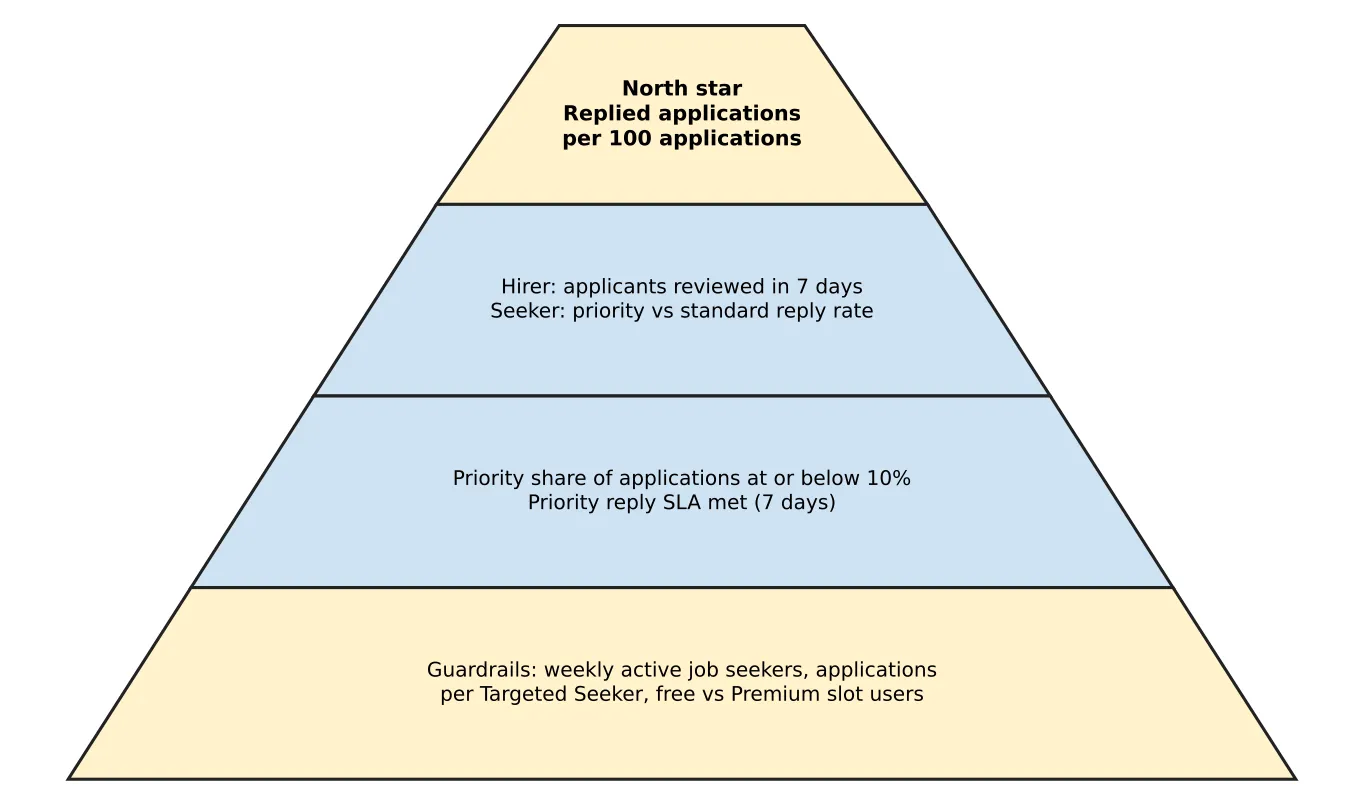
North star: replied applications per 100. A cluster test of at least 6 weeks, and a 0.13% break-even uplift that is a bound, not a forecast.
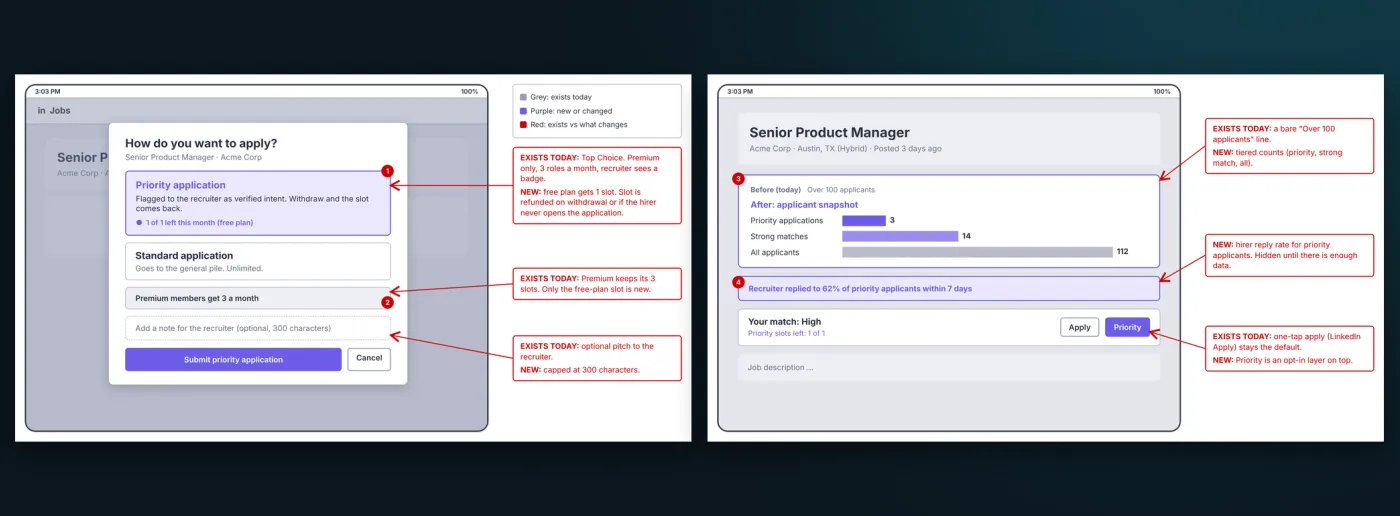
The experimentEach screen as it is today, then as proposed. Grey exists today; purple is new or changed.
1 / 6
Step 01
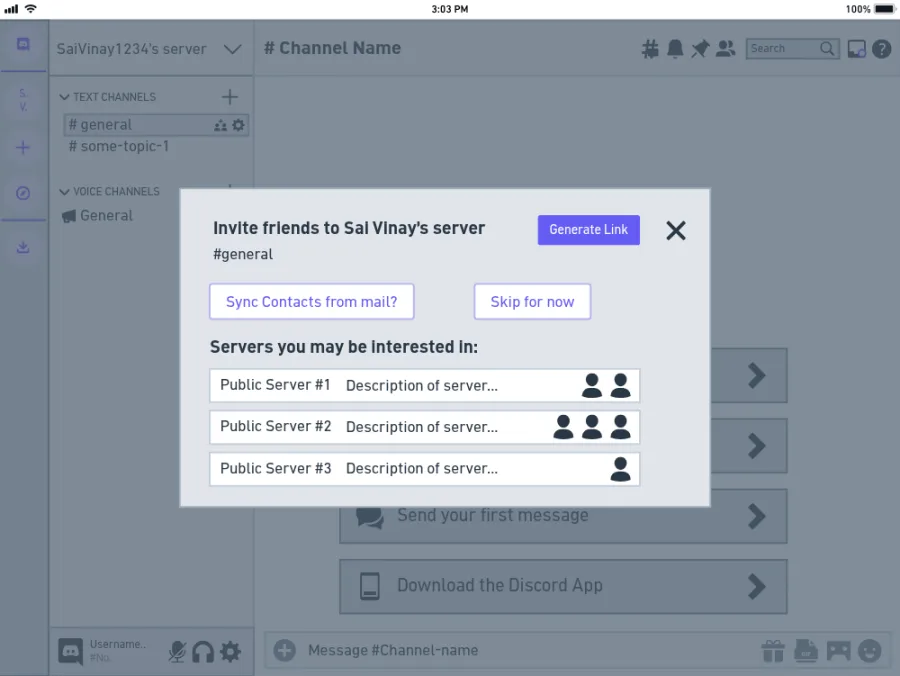
Today's Top Choice dialog: a real LinkedIn screen captured in Oct 2026, the account email hidden.
Step 02
The proposed choice of Priority or Standard. Proposed screen, not LinkedIn's product.
Step 03
A real LinkedIn job page captured in Oct 2026, the account email hidden.
Step 04
The proposed snapshot and Priority button. Proposed screen, not LinkedIn's product.
Step 05
An illustration of today's list, not a LinkedIn screen: a real hirer view needs a hirer seat.
Step 06
The proposed priority lane with filters and a fit-and-intent sort. Proposed screen, not LinkedIn's product.
Job seekers
Job seeker, in scope
10.8M a month, about 15 applications each
Job seeker, in scope
32.4M a month, about 4 applications each
Job seeker, in scope
43.2M a month, about 2.5 applications each
Hirers
Hirer, in scope
0.37M a month, in-house or agency
Hirer, in scope
0.84M a month, 1 to 2 roles at a time
Out of scopePassive Professionals (208.8M, about 0.1 applications a month each) rarely apply, and the 64.8M with no hiring intent are not part of the hiring problem. Hirer counts are order of magnitude: 100 applications per posting is an assumption, and at 50 they roughly double.
| Persona | Share of actives | Global (M) | US (M) | Applications a month each | Applications a month (M) |
|---|---|---|---|---|---|
| Passive Professional | 58% | 208.8M | 44.7M | 0.1 | 20.9M |
| Targeted Seeker | 9% | 32.4M | 6.9M | 4 | 129.6M |
| Volume Applicant | 3% | 10.8M | 2.3M | 15 | 162.0M |
| Early-Career Entrant | 12% | 43.2M | 9.3M | 2.5 | 108.0M |
| No hiring intent (out of scope) | 18% | 64.8M | 13.9M | n/a | n/a |
Sizes are guesstimatesRegistered members are third-party (1,200M); the active share of 30% is an assumption, which gives 360M monthly active. Applications are 420.2M a month (9,600 a minute, the midpoint of two sources that disagree by about a third; range 359.0M to 481.5M). The persona applications sum to 420.5M, within 0.1% of that, but only because the Volume Applicant intensity was set to make it hold. 39% of applications from 3% of actives is an output of the assumptions, not evidence.
| Persona | Job |
|---|---|
| Volume Applicant | Get a reply without a full-time job of applying. |
| Targeted Seeker | Show intent to the few roles that matter, without gaming the system. |
| Early-Career Entrant | Be seen beyond a thin resume with no experience. |
| Recruiter | Find the few strong, interested applicants without reading 100 profiles. |
| Hiring Manager | Fill the role without drowning in applications. |
| Feature | Delight | Hard to copy | Margin moving | Priority |
|---|---|---|---|---|
| F1 Priority Application | High | High | High | High |
| F3 Hirer Inbox Lane | High | Medium | High | Medium |
| F2 Applicant Snapshot | Medium | Medium | Medium | Medium |
| F5 Response Commitment | Medium | High | Medium | Medium |
| F4 Application Budget | Low | Low | Medium | Low |
How the scores are readDHM scores each feature High, Medium or Low on Delight to Customers, Hard to Copy and Margin Moving. Priority is a judgment, not a sum: it weights how directly a feature acts on the root cause, application signal collapse. These are hypotheses to re-run after 5 to 8 interviews.
F1
A scarce, verified, refundable slot for any member to flag the jobs they really want.
F2
Three counts replace Over 100 applicants, so seekers can judge their odds.
F3
Hirers see the benefit without training, so the lane appears by default.
F4
A confirm-intent step beyond a daily threshold. Conditional, in the last phase.
F5
Closes the loop on the hirer's side.
A limited monthly allowance means a priority application says I chose this one.
Slots are tied to a verified member and come back on withdrawal or if the hirer never opens the application.
Hirers see a 7-day reply expectation and seekers see the hirer's reply rate.
A priority lane and a fit-and-intent sort cut review time and soften the early-applicant advantage.
Sizing the slot allowance
| Slots a month | Adoption among job-active seekers | Priority applications (M a month) | Share of all applications |
|---|---|---|---|
| 1 | 30% | 25.9 | 6% |
| 1 | 60% | 51.8 | 12% |
| 2 | 30% | 51.8 | 12% |
| 2 | 60% | 103.7 | 25% |
| 3 | 30% | 77.8 | 19% |
| 3 | 60% | 155.5 | 37% |
One free slot at 30% adoption is about 6% of applications, which a hirer can review in full. Three slots at 60% would be about 37%, which recreates the noise. At 60% adoption even one slot passes the 10% guardrail, so the allowance is tuned per market and is an experiment arm, not a fixed number. Adoption is a guess.
Unlimited Standard remains, so volume is not capped in phases 1 and 2.
They cannot pay to see priority applicants first, which keeps the signal clean.
One open priority application per company at a time stops piling into one employer.
If intent is Premium only, early-career seekers are shut out and the persona rationale fails.
The badge promises attention, not an outcome.
Phase 0 · Weeks 0 to 6
Phase 1 · Quarter 1, US
Phase 2 · Quarter 2
Phase 3 · Quarters 3 to 4, conditional
Replied applications per 100 applications (a hirer reply or status change within 14 days)
Weekly active job seekers, applications per Targeted Seeker and hirer posting volume: no decline beyond 2% in treated markets
Baseline is unknown and is measured in phase 0. Hypothesis: up 15% relative in treated markets.
Share of applicants reviewed in the first 7 days, and time to first shortlist
Priority share of applications per posting at or below 10%
Hypothesis: review share up and time to shortlist down. This is the hirer-side outcome the brief asks for.
Reply rate to priority versus standard applications from the same user
Free-slot users must not fare worse than Premium users
Top Choice claims +43% recruiter messages (claimed, may not generalize). Hypothesis: priority beats standard by a clear margin.
A market by occupation cluster, for example Austin product roles, because applicants and hirers interact and user-level randomization would leak.
Control (today). Treatment A: F1 + F2 + F3. Treatment B: A + F5, in phase 2.
With a 10% baseline reply rate and a 15% relative lift, about 6,683 applications per arm at 80% power and 5% significance; about 20,049 with a design effect of 3 for clustering. The baseline is a guess.
At least 6 weeks, so a full hiring cycle shows up in replies.
Stop if weekly active job seekers fall more than 2% in treated markets, or applications per Targeted Seeker fall more than 5%.
Compare priority usage and reply rates by seniority, geography and proxy groups. Free-slot users must not fare worse than Premium users.
A bound, not a forecastThis is a scenario model, not proof: the revenue effect cannot be measured until the experiment runs. A year-one cost of $12M against an exposed base of about $9.25B breaks even at a 0.13% uplift. Being this easy to clear is itself a warning: treat the revenue lines as a bound. The real risks are seeker-side harm, fairness and regulation, not whether the program pays back.
| Input | Value | Source and confidence |
|---|---|---|
| Talent Solutions revenue | $8.4B | FY2024 per a secondary source (FourWeekMBA) that conflicts with other totals. Low to medium confidence. |
| Premium revenue | $1.7B | Disclosed by LinkedIn for 2023. High confidence on the figure, but stale. |
| Share of Premium from job-seeker use | 50% | A guess. The model only counts this share as exposed, $850M. |
| Year-one program cost | $12M | 22 FTE at $0.35M loaded plus $4.3M for data, legal, research and infrastructure. A guess. |
| Scenario | Premium effect | Talent Solutions effect | Gross ($M) | Net of cost ($M) | Reading |
|---|---|---|---|---|---|
| Downside | -2% on exposed Premium (-$17M) | 0.0% on Talent Solutions ($0M) | -17 | -29 | Slots cannibalize Top Choice, hirers unmoved |
| Base | +5% on exposed Premium ($43M) | 0.5% on Talent Solutions ($42M) | 85 | 73 | Modest conversion and retention lift |
| Upside | +10% on exposed Premium ($85M) | 1.5% on Talent Solutions ($126M) | 211 | 199 | Hirer value clearly improves |
If priority needs Premium, wealthier seekers get an edge and early-career seekers lose.
If slots are generous, everyone flags everything and the signal dies.
Seekers burn slots and get silence, so trust drops further.
Giving free users a slot may reduce Premium conversion. This is the downside scenario.
Auto-apply tools can spend slots on bad targets.
Ranking people by intent and fit is high-risk employment AI in the EU, and US cities and states regulate hiring tools. Timelines depend on legal review.
For legal-dependent steps, publish gates instead of dates and re-plan at each gate.
Slots, snapshot and lane ship independently, so one blocked dependency does not stop the others.
Six weeks of interviews, baseline and legal review, then a go or no-go on the Top Choice replication.
Do not build F4 before there is data on Volume Applicants.
PR note, as written for the PRD
Every member can now flag the jobs they really want. Recruiters see priority applicants first and can reply to them within days. Job pages now show how many strong matches and priority applicants a role has, instead of Over 100 applicants. Pricing: free plan, 1 priority slot a month, real and refundable. Premium, 3 priority slots a month at launch, matching Top Choice today. Hirers cannot buy priority placement; billing is unchanged.
The documents cite these. Each opens in a new tab.
HR Dive, LinkedIn launches Top Choice (23 October 2023) (opens in a new tab)
Microsoft FY26 Form 10-K (opens in a new tab)
Microsoft 8-K, FY27 investor metrics restatement (opens in a new tab)
Gibson Dunn, EU AI Act omnibus agreement (opens in a new tab)
LinkedIn News, Premium revenue (2023) (opens in a new tab)
SocialBee, LinkedIn statistics (Statista figures) (opens in a new tab)
Clever CV, applications per minute (opens in a new tab)
Wellfound Help, application limits (opens in a new tab)
Indeed newsroom, Apply For Me test (July 7, updated August 4, 2026) (opens in a new tab)
HeroHunt, Indeed pricing for employers 2026 (third-party) (opens in a new tab)
Recruiting News Network, GoodTime 2026 Hiring Insights Report (June 2, 2026) (opens in a new tab)
Pin, best job posting sites 2026 (third-party pricing) (opens in a new tab)
The three documents behind the page, as supplied. Each is also linked from the section it supports.
Download the original documents (zip)PDF · 2026
PDF · 2026
PDF · 2026