01
Five workstreams, five pages
Support, implementations, knowledge, managed services and reporting each get a page over one shared demo dataset.
The surfaces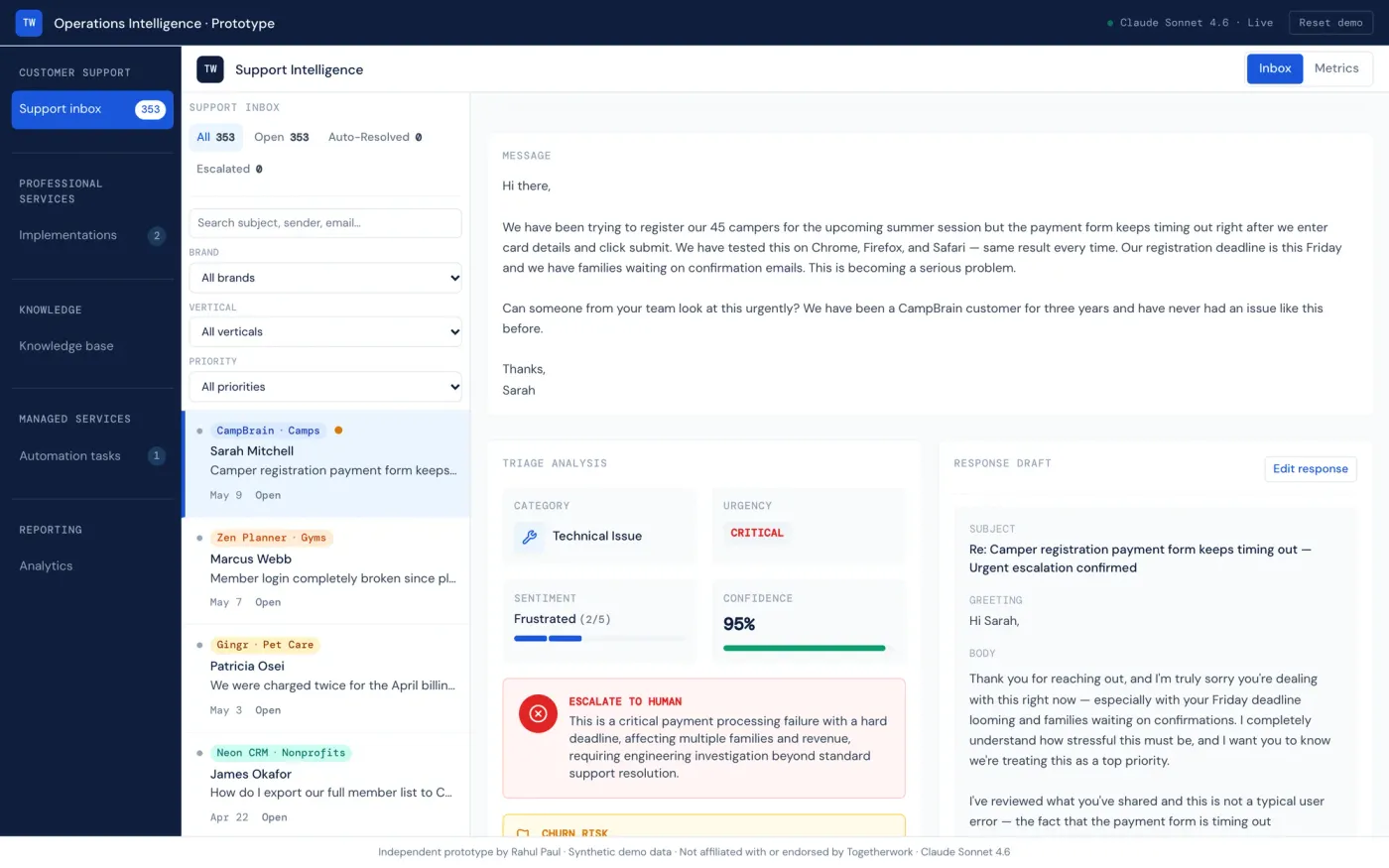
Technical build
AI-assisted operations across five workstreams.
A prototype that uses Claude to triage support, guide implementations, find knowledge gaps and report across one demo experience.
Open live product (opens in a new tab)View GitHub (opens in a new tab)
Support, implementations, knowledge, managed services and reporting each live in a different workflow.
Reading a ticket, drafting a reply, building an onboarding checklist or spotting a documentation gap is manual and repeated.
Five pages, one per workstream, share a single demo dataset and a single AI layer.
Each page turns its input into a structured result a person can act on.
An independent prototype built for demonstration. All data is synthetic, it makes no claim about real usage or efficiency gains, and it is not affiliated with or endorsed by Togetherwork.
The ideaAn AI-assisted operations prototype: five pages, one per workstream, share a demo dataset and one AI layer, and turn each input into a structured next action a person can act on.
01
Support, implementations, knowledge, managed services and reporting each get a page over one shared demo dataset.
The surfaces02
Each page turns its input into a structured result: a routed ticket, a tailored checklist or a ranked documentation gap.
The deployed screens03
An AI-drafted reply is edited before it is approved or escalated, and a routing decision shows its confidence score.
The deployed screens04
The browser reaches Claude through a Pages Function with request guards, after the first version left the key in the browser bundle.
The architecture05
Each surface is labelled implemented or partial, and the hours-saved figure is modeled from assumed minutes, never measured.
The surfaces06
The partly built pages come first, then persistence, accounts and audit logging.
What I would improveA dense, desktop-first layout.
1 / 7
Step 01
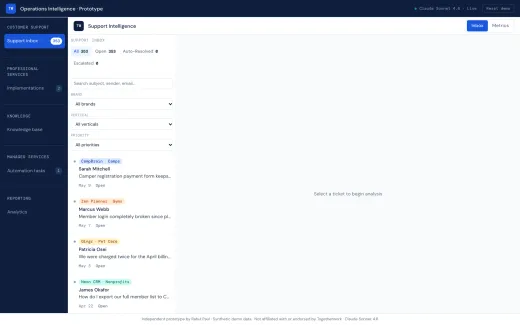
A filterable inbox of 353 seeded tickets: status tabs, search, and brand, vertical and priority filters. Nothing is selected yet, so the detail pane waits for a ticket.
Step 02
Selecting a ticket shows the message, a triage panel (category, urgency, sentiment, confidence, routing decision and knowledge-base suggestions) and an editable drafted reply with Approve & Send or Escalate. Generated by Claude through the server-side proxy.
Step 03
Metric cards (active, on track, at risk, average completion) act as filters above a table of eight client onboardings with product, a five-stage progress track, AI status, risk and go-live date.
Step 04
Expanding a row shows a next action, a tickable checklist, blockers and a configuration document for that client. Generated by Claude through the server-side proxy.
Step 05
Documentation gaps ranked by how many tickets point at them, each with category, affected brands and a “No draft” badge. Article browsing sits above; AI draft generation is not built yet.
Step 06
Queue, running and exception counts, status filters and a task list with automation percentage and a high-severity exception callout. Run workflow simulates scheduled, running, complete; it is a simulation, not an integration.
Step 07
After approving six tickets and running one workflow: deflection against a baseline, a modeled hours-saved figure, churn prevented and a seven-day volume chart. Hours saved comes from assumed minutes per unit, not measurement, and offline samples are not counted as AI actions.
Screenshots of each appear in the walkthrough below.
The deployable architecture, not the local-only prototype. The original app called Anthropic from the browser with a key in the Vite bundle, which is safe only on a laptop. The groups separate what was originally built from the changes made to host it publicly.
The React client and synthetic data, as built.
Implemented in the prototype
Five pages with client-side state. Reset restores the seed data. History-API routes (/support, /implementations, /knowledge, /managed-services, /analytics) were added for deployment.
Implemented in the prototype
353 tickets (the first ten handcrafted, the rest generated), plus implementations, articles, tasks and analytics history, bundled into the app.
Added to make a public deployment safe; not part of the original source.
Implemented in the prototype
Hosts the static Vite build and falls back to the app shell for the five routes.
Implemented in the prototype
Accepts an operation name (triage, response or implementation) plus demo data, builds the prompt from server-held templates and calls Anthropic with the server-side key.
Implemented in the prototype
Same-origin check, body and field size caps, per-operation token caps, a best-effort per-IP rate limit and an AI kill switch.
Implemented in the prototype
Rule-based fallback shown, and labelled, when the AI is unavailable, rate limited or erroring. Analytics does not count it as AI output.
Called only from the server.
Implemented in the prototype
Returns JSON that the app parses with parseModelJson().
Not in the prototype.
Proposed / evaluated
Ticket, implementation and article state currently lives only in the browser session.
Proposed / evaluated
The prototype has no accounts, authorization or audit trail.
Proposed / evaluated
Support desk, PSA, billing and payroll systems are mocked, not connected.
Every AI action runs on Claude Sonnet 4.6.
A ticket in Support, or an implementation row.
BrowserOnly the operation name and demo data leave the browser.
POST /api/claudeA server-held system prompt and a template filled from validated fields.
Pages FunctionThe prompt requires a single JSON object and no prose.
Anthropic APIparseModelJson() handles fenced or wrapped JSON before parsing.
BrowserTriage fields, a drafted reply, or a checklist with blockers and a next action.
BrowserApprove & Send or Escalate, edit the draft, tick checklist items. State changes stay in the session.
BrowserChoices visible in the code, each with what it bought and what it gave up.
Every prompt asks for one JSON object with a fixed shape. parseModelJson() strips code fences and surrounding text before parsing, and a failed parse becomes a retry state.
Triage returns auto-resolve or escalate with a confidence score and a reason. The drafted reply is editable, and a person approves, overrides or escalates.
All state lives in React. Reset restores seeded tickets, implementations, articles and tasks and clears AI caches.
The browser sends an operation name and demo data, never a prompt or a key. A Pages Function holds the prompts and the secret, and caps request size, output tokens and call rate.
When the AI is unavailable, rate limited or failing, the app shows rule-based samples marked “Offline sample · AI unavailable” and leaves them out of AI counts.
Challenges taken from the code, its comments and the audit rather than recalled after the fact.
Security lessonA Vite-exposed Anthropic key suits only a local prototype. Putting the project on a public domain required moving inference behind a server-side boundary first, with validation, size and rate limits, and an AI kill switch.
Items are marked Partial when some of the work exists and Planned when none does.
The live product on synthetic data, and the source with its deployment notes and audit.
Download the original documents (zip)Live product
Source code